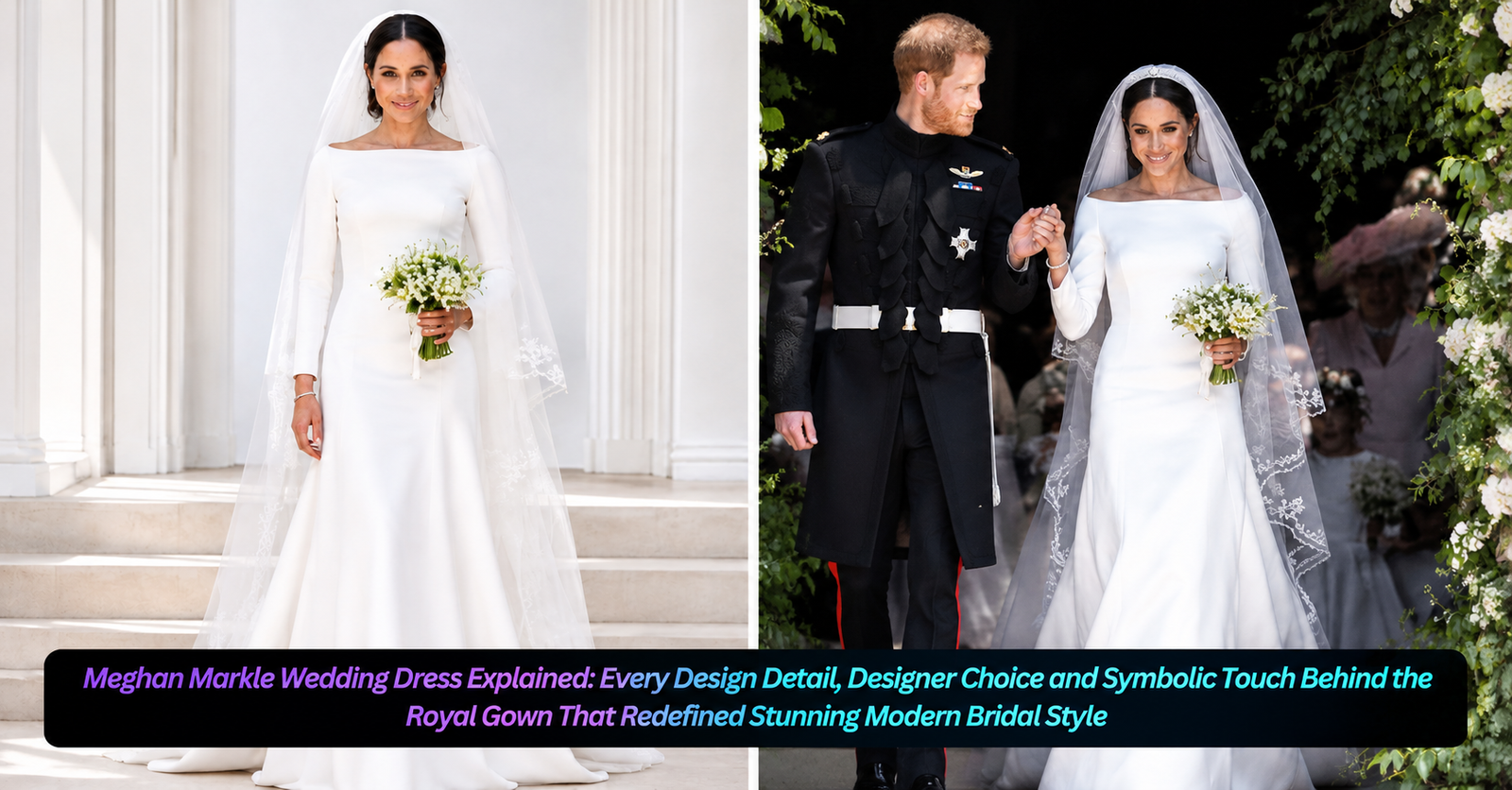
When Meghan Markle stepped out of the Rolls-Royce at Windsor Castle on 19 May 2018, millions of viewers were waiting to see one thing above all else: the dress. Fashion editors, bridal designers and ordinary viewers had spent months guessing which house would dress her. What they saw was a clean, sculpted white gown with a bateau neckline, three-quarter sleeves and a veil so long it seemed to follow her up the chapel steps. The Meghan Markle wedding dress was not a fairy-tale ballgown, and that was precisely what made it unforgettable.
This guide goes beyond the headlines. It explains who designed the gown, how it was constructed, what each element was meant to say, how it compared with her second reception look, and how brides today can borrow its ideas without a royal budget. Whether you are researching bridal fashion history, planning your own wedding or simply curious, you will find the details laid out in plain language, with the context that makes them meaningful.
What Is the Meghan Markle Wedding Dress?
The Meghan Markle wedding dress is the bridal gown the Duchess of Sussex wore to marry Prince Harry at St George’s Chapel, Windsor Castle, on 19 May 2018. It was designed by Clare Waight Keller, then artistic director of the French fashion house Givenchy, and was made from pure white double-bonded silk cady with a minimalist silhouette, a bateau neckline, three-quarter sleeves and a train of roughly five metres.
That direct answer is the short version. The longer version is that the dress worked as a piece of public storytelling. Every royal bride is expected to balance tradition with personality, and Meghan did it through restraint. Instead of lace-heavy sleeves or a voluminous skirt, she chose a pared-back structure that let the fabric, the cut and the veil do the talking. In fashion terms, it was a masterclass in how a single, confident design decision can say more than a dozen embellishments.
The gown also carried a quiet message about identity. Meghan was an American actress, a divorcee and a woman of mixed heritage marrying into one of the most traditional institutions in the world. A modern, architectural dress signalled that she was joining the monarchy without erasing herself.
The Designer Behind the Gown: Clare Waight Keller and Givenchy
For months before the wedding, speculation had pointed to British names such as Ralph and Russo, Erdem and Roland Mouret. The final choice surprised the fashion world. Clare Waight Keller, a British designer who had become the first woman to lead the historic house of Givenchy in 2017, was announced as the creator of the Meghan Markle wedding dress only after the bride had arrived at the chapel.
The pairing made strategic and emotional sense. Givenchy carries a particular glamour thanks to its founder, Hubert de Givenchy, who famously dressed Audrey Hepburn and shaped the clean, elegant ideal of mid-century style. Meghan, a long-time admirer of classic Hollywood elegance, was drawing on that lineage. At the same time, choosing a British designer leading a French house allowed the couple to honour the host country while presenting something international. Waight Keller, who trained at the Royal College of Art, brought a quiet, modern sensibility that matched the bride’s taste.
The designer and the bride reportedly met several times in London over the preceding months, with fittings carried out both in the United Kingdom and in Paris at the Givenchy ateliers. The process mattered as much as the result. Bespoke bridal work of this kind is a conversation: the client explains how she wants to feel, and the designer translates that into proportion, fabric and line. The outcome here was a dress that looked effortless, which in couture usually means the work behind it was extraordinarily precise.
Design Details: The Bateau Neckline, Sleeves and Silhouette
The most discussed feature of the gown was its bateau neckline, a wide, shallow curve that stretches from shoulder to shoulder and sits just below the collarbone. Fashion writers pointed out that this neckline does two things at once. It frames the shoulders and clavicle in a sculptural way, and it provides a modest, church-appropriate coverage that suited the formal setting of a royal ceremony.
The three-quarter sleeves added a graceful, contemporary touch, and the structured seams gave the bodice a crisp, almost architectural feel. Below the waist, the skirt flowed out in a subtle A-line shape rather than a full princess form, finishing in a train that unfolded behind her. Think of it as the difference between a tailored blazer and a costume: every line was deliberate, and nothing was there for decoration alone. Waight Keller described the aim in terms of purity of line, and the result echoed the less-is-more philosophy that has guided minimalist couture for decades.
Another often-overlooked detail is the seam work. The dress used a single, graceful curve that began at the neckline and traveled through the waist, so the eye followed the body rather than stopping at embellishment. This is why photographs of the gown still look fresh years later. Trends in bridal fashion come and go, but clean geometry rarely dates.
Fabric and Craftsmanship: Why Silk Cady Mattered
The Meghan Markle wedding dress was made from double-bonded silk cady, a dense, matte silk with enough body to hold sculpted shapes without clinging. According to details released at the time, the fabric was cut and sewn by hand and finished using silk thread. Where lace and tulle can soften a look, silk cady gives structure, which is why it is favoured by designers aiming for a modern, graphic result.
For readers who are not fashion specialists, an analogy helps. Imagine the difference between a crisp cotton shirt and a floaty chiffon blouse. The first holds its shape and shows precise seams, while the second drapes and moves. Silk cady behaves like the crisp shirt but with a luxurious, subtle sheen. That quality allowed the bateau neckline to stay perfectly crisp and the train to fall in a clean, controlled sweep.
The workmanship also involved extensive handwork. Couture houses typically use hand-finishing for seams, hems and internal structure, because those hidden details determine how a gown moves and photographs. A dress like this can take hundreds of hours across fitting, pattern making and sewing. Since final fittings and adjustments continued close to the wedding date, the atelier had to maintain absolute precision under intense scrutiny, which is a reminder that minimalism is often harder to execute than ornament.
The Sixteen-Foot Veil and the Commonwealth Flowers
If the dress was restrained, the veil was the emotional centre of the look. Made from silk tulle and measuring roughly sixteen feet, or about five metres, it was edged with hand-embroidered flowers. These were not random blooms. The embroidery represented the plant life of the fifty-three Commonwealth countries, created in silk thread and organza, with each country’s flower included in a symbolic floral border.
The veil also carried personal meaning. Meghan added the California poppy, the state flower of her home, and the wintersweet, which grew in the grounds of Kensington Palace near the couple’s home. A piece of fabric from the gingham dress she wore on the day she met Harry was reportedly stitched into the lining, serving as her “something blue” in line with the old rhyme, “something old, something new, something borrowed, something blue.”
The veil’s design solved a real problem. A minimalist dress can feel plain in a cathedral-scale setting, but a heavily decorated dress might compete with the architecture. By moving the decoration to the veil, the design allowed the gown to stay clean while the veil added drama, symbolism and a sense of occasion. When she walked up the chapel steps, the long tulle created a flowing, cloud-like silhouette that photographers loved.
The Tiara, Jewelry and Finishing Touches
The headpiece anchoring the veil was Queen Mary’s diamond bandeau tiara, a piece made in 1932 with a central brooch dating back to 1893, lent by Queen Elizabeth II. Its flat, band-like shape sat low on Meghan’s head and held the veil in place, which complemented the simplicity of the dress. A larger, more ornate tiara could have overwhelmed the clean lines, so the choice reflected how closely the styling team worked with the bridal design.
Other elements kept the look cohesive. Her shoes were made by Givenchy in silk satin, her makeup was soft and natural, and her hair was swept into a loose, low bun, an intentionally relaxed finish that echoed the polished-but-unfussy mood of the whole outfit. The diamond earrings and bracelet were also loaned by the royal family, grounding the modern gown in royal tradition.
Think of the styling as a chorus supporting a lead singer. Nothing competed with the silhouette, yet each accessory had a purpose: structure for the veil, sparkle at the head, softness for the face. This balance is a good lesson for brides who feel tempted to add every detail, because cohesion usually beats abundance.
The Second Look: Stella McCartney at the Evening Reception
After the ceremony, Meghan changed for the evening reception at Frogmore House into a very different outfit by British designer Stella McCartney. The second dress was a white silk crepe gown with a high halter neckline, a bare back and a sleek, fluid fall. A fitted bodice and a long skirt created a fashionable, red-carpet silhouette, and she paired it with a diamond aquamarine ring that had belonged to Princess Diana.
The contrast between the two outfits showed how modern brides often use multiple looks for different moments. The ceremonial gown honoured tradition, while the reception dress allowed for dancing, relaxation and a more personal style. McCartney’s reputation for sustainable, cruelty-free fashion also added a values-driven layer to the second outfit.
For the fashion record, the evening dress showed how Meghan’s taste leaned toward clean, body-skimming lines rather than heavy decoration. Together, the two gowns told a consistent story about restraint, craftsmanship and subtle symbolism.

Meghan Markle Wedding Dress at a Glance
The table below summarises the key elements for anyone who wants a quick reference. It brings together the facts most readers look for when searching for this topic.
| Element | Detail |
|---|---|
| Wedding date | 19 May 2018 |
| Venue | St George’s Chapel, Windsor Castle |
| Designer | Clare Waight Keller for Givenchy |
| Fabric | Double-bonded silk cady |
| Neckline and sleeves | Bateau neckline with three-quarter sleeves |
| Train length | Approximately five metres |
| Veil | Silk tulle, about sixteen feet, with embroidery for the fifty-three Commonwealth countries |
| Personal touches | California poppy, wintersweet and gingham fabric in the lining |
| Tiara | Queen Mary’s diamond bandeau, loaned by Queen Elizabeth II |
| Reception dress | White silk crepe halter gown by Stella McCartney |
This summary captures why the Meghan Markle wedding dress remains a reference point in bridal fashion. It combines couture technique, modern minimalism and layered symbolism in a way that few royal gowns have managed.
Why the Gown Resonated: Symbolism and Public Reaction
Reactions to the dress were largely admiring. Fashion critics praised its restraint, and many commentators noted that it marked a break from the lace-heavy, long-sleeved royal brides of the past. The gown felt like a statement about a modern woman choosing her own aesthetic within a historic framework.
There was also a subtle cultural message. Meghan had publicly spoken about her career, her heritage and her ambitions, and her bridal choice reflected independence rather than conformity. By choosing a woman designer from a heritage house, she supported female leadership in fashion, which many observers saw as an intentional gesture. The dress therefore functioned as both an aesthetic object and a cultural signal.
Not everyone agreed, of course. Some traditionalists felt the dress was too plain for a royal wedding, and a few critics said the neckline was unflattering from certain camera angles. These reactions are useful to remember because they show that even widely praised designs divide opinion. What mattered is that the gown felt true to the woman wearing it.
How to Get the Look: Problem and Solution for Real Brides
The challenge most brides face is that a couture silk cady gown with hand-finished seams costs far more than a typical wedding budget allows. The solution is to separate the principles from the price tag. The first principle is a clean silhouette: a bateau or boat neckline, structured sleeves and a smooth, unembellished skirt. Many bridal labels and made-to-order dressmakers offer these cuts in crepe or satin, which mimic the weight and sheen of silk cady at a fraction of the cost.
The second principle is putting the drama in one place. Meghan’s dress was plain, and her veil carried the emotion. A bride can follow the same strategy by choosing a simple gown and investing in a cathedral veil, a statement headpiece or meaningful embroidery. Adding personal symbols, such as a flower from her home town or a scrap of fabric from a significant outfit, delivers the sentimental effect without extra cost.
A final practical tip involves fittings. Minimalist dresses show every flaw in tailoring, so allow generous time for alterations. A skilled seamstress can adjust a neckline or sleeve length to mimic the structured look, and good tailoring often matters more than the label inside the dress.
Where Is the Dress Now?
After the wedding, the gown was displayed to the public as part of an exhibition at Windsor Castle, where visitors could examine the fabric, the embroidery and the veil up close. Seeing the dress in person revealed details that television cameras could not capture, including the subtle sheen of the silk and the precision of the seams.
Like most royal wedding gowns, it is a significant historical garment and is kept carefully by the couple. Fashion museums and royal collections value such pieces because they document craft traditions and cultural moments. For anyone researching the Meghan Markle wedding dress, exhibition catalogues and official royal statements remain the most reliable sources for verified details.
Frequently Asked Questions
Who designed the Meghan Markle wedding dress?
The gown was designed by Clare Waight Keller, who was then the artistic director of Givenchy and the first woman to hold that role at the house. She worked closely with Meghan over several months, with fittings in both London and Paris, to create a design that balanced modern minimalism with royal tradition.
What is the Meghan Markle wedding dress made of?
The dress was made from double-bonded silk cady, a thick, matte silk that holds structure beautifully. The seams were hand-finished using silk thread, and the structured fabric allowed the bateau neckline and the long train to keep a clean, sculptural shape.
How long was Meghan Markle’s veil?
The veil measured about sixteen feet, or roughly five metres, and was made of silk tulle. It was embroidered with flowers representing the fifty-three Commonwealth nations, plus the California poppy and wintersweet, which gave it deep personal and symbolic meaning.
Did Meghan Markle wear a second dress on her wedding day?
Yes. For the evening reception at Frogmore House, she changed into a white silk crepe halter-neck gown by Stella McCartney. The sleek, modern design contrasted with the ceremonial gown and showed her preference for clean, elegant lines.
Can you buy a dress similar to the Meghan Markle wedding dress?
You cannot buy the original, but many designers and bridal boutiques offer similar styles featuring a bateau neckline, three-quarter sleeves and a smooth crepe or satin skirt. Choosing a minimalist cut and investing in a dramatic veil is the best way to capture the spirit of the Meghan Markle wedding dress without a couture budget.
Conclusion
The Meghan Markle wedding dress succeeded because every choice, from the Givenchy atelier to the Commonwealth embroidery, served a clear idea. It was modern without being cold, traditional without being stuffy and personal without being showy. The silk cady gave it structure, the bateau neckline gave it grace, and the veil carried the story. Years later, it still shapes how designers and brides think about elegance.
The lasting takeaway is simple: great bridal style comes from clarity, not clutter. The Meghan Markle wedding dress proves that a single, well-considered design can outlast trends, and that the most memorable gowns are the ones that reflect the person wearing them.