Some outfits belong to a season. Others belong to a century. The Jackie Kennedy pink suit sits firmly in the second group: a strawberry-colored wool ensemble that most people recognize in half a second, even if they cannot name the designer, the year, or the city where it was worn. It has been studied by fashion historians, archivists, and biographers, and it still sparks arguments about who actually made it and why nobody can see it today.
This guide pulls the verified facts into one place. You will learn what the suit looked like, how the Chanel and Chez Ninon connection really worked, why a First Lady needed that workaround, and where the garments ended up. Along the way, the well-documented facts are kept separate from the myths that circulate online, so you can treat this page as a dependable reference rather than another recycled summary.
What Is the Jackie Kennedy Pink Suit?
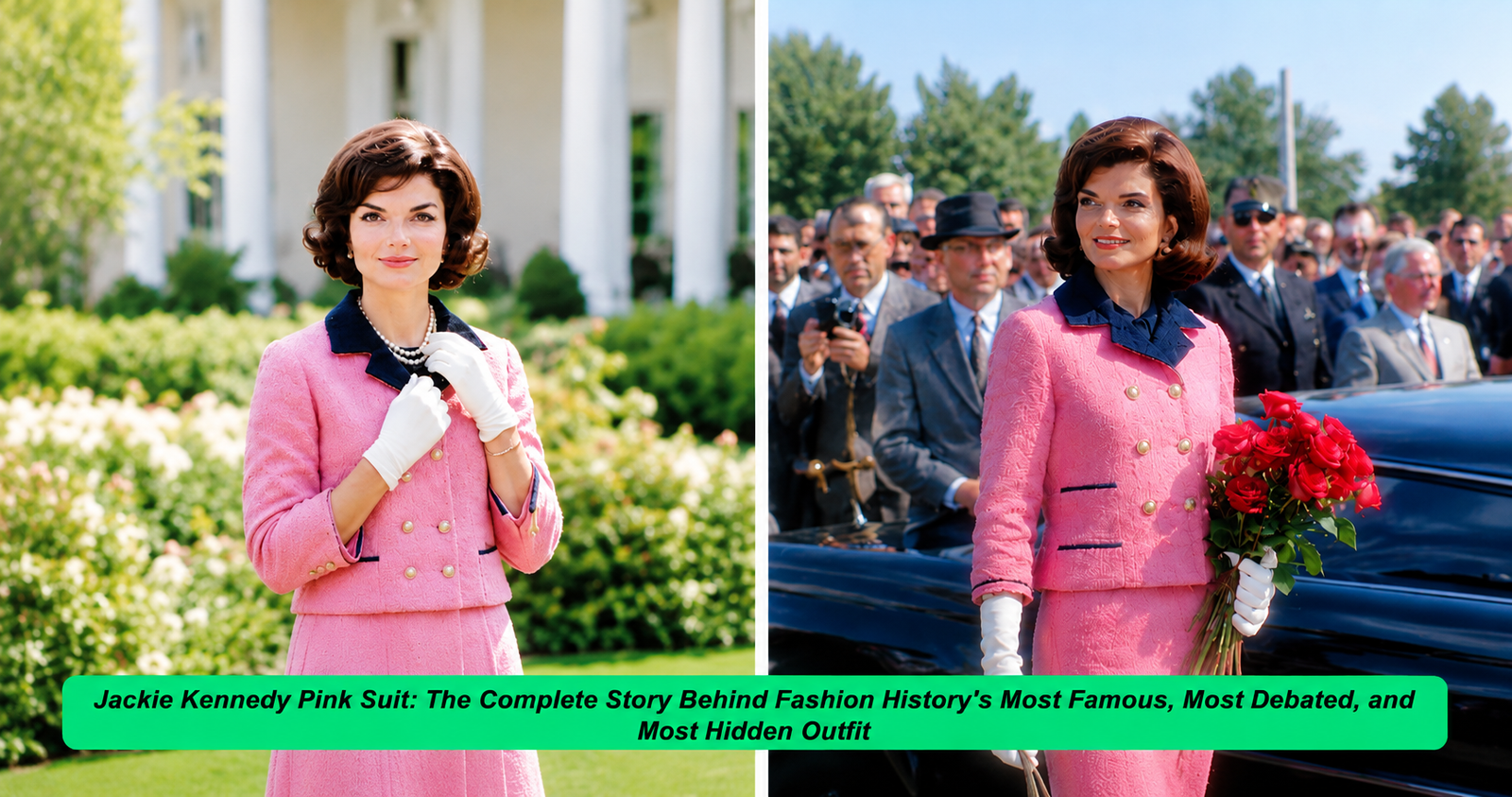
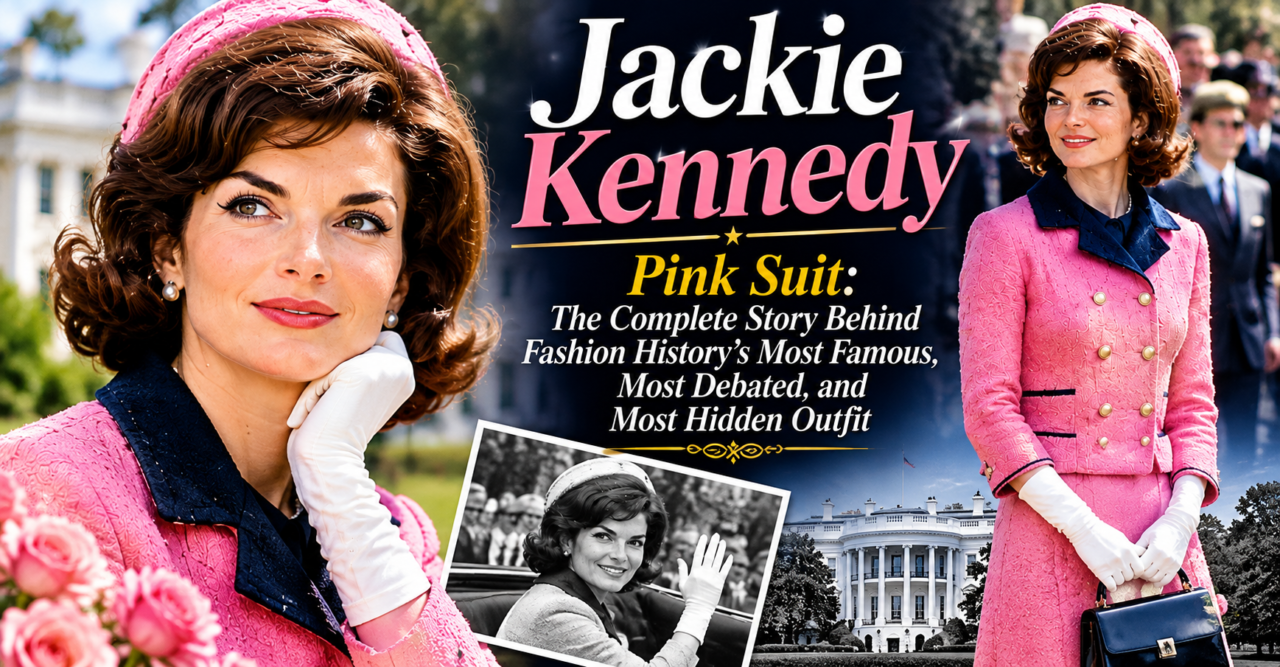
The Jackie Kennedy pink suit is a strawberry pink wool bouclé suit with navy blue trim, worn by First Lady Jacqueline Kennedy in Dallas, Texas, on November 22, 1963, the day President John F. Kennedy was assassinated. Its design comes from Chanel’s Fall/Winter 1961 collection, but it was made by the New York salon Chez Ninon using an authorized method called line-for-line copying. The suit is now held by the National Archives in Maryland and is closed to public viewing.
That short definition hides a surprisingly layered object. The suit is a piece of couture history, a case study in how diplomacy and public expectation shaped a wardrobe, and a historical record that the Kennedy family chose to protect. Each layer explains why the garment still draws attention more than six decades later, and why so many articles about it contradict one another.
Design Details: Fabric, Color, and Silhouette
Bouclé is a looped, textured yarn woven into a tweed-like cloth, and it was a signature of the Chanel house. Here it appeared in a warm pink, usually described as strawberry or raspberry, set against a contrasting navy blue collar. The jacket followed the cardigan-style shape that Chanel made famous: straight, slightly boxy, and cut to move with the body instead of constraining it. Think of it as the opposite of a corseted evening gown. It was tailored, yet comfortable enough for a long day of public appearances.
The accessories finished the picture. A matching pillbox hat, a small, rounded, brimless style that sits on top of the head, and white gloves completed the daytime look, while a navy blouse, stockings, blue shoes, and a handbag were worn with it. A helpful analogy is a well-edited room: each piece is simple, but together they feel deliberate. That restraint is a big reason the ensemble reads as timeless rather than dated, and it is why designers still point to it when they talk about daytime elegance.
Chanel or Chez Ninon: Settling the Origin Debate
For years, writers argued over whether the suit came from Paris or New York. The honest answer is both. The design came from Chanel, but the garment itself was cut and sewn at Chez Ninon, a Park Avenue salon that specialized in authorized versions of European designs. Chanel’s atelier supplied the fabric, buttons, and trim, and the arrangement carried the house’s approval.
Justine Picardie’s 2010 biography of Coco Chanel helped settle the question by describing line-for-line production as a licensed process rather than forgery. In plain terms, a line-for-line copy reproduces every seam, line, and proportion of the original. Picture a licensed cover version of a song, played note for note with the composer’s permission. That comparison shows why calling the Jackie Kennedy pink suit a knockoff is unfair, while calling it a pure Paris-made Chanel is also inaccurate.
Jackie was also a loyal customer, not a one-time buyer. Wetzbarger, quoted by Vice, noted that she “had an account with Chez Ninon for a couple of years before the inauguration.” That detail matters because it shows the suit came out of an established relationship with a trusted workroom, not an improvised purchase.
Why a First Lady Needed an American-Made Solution
Jackie loved French couture, but a First Lady was expected to wear American-made clothing. Wearing imported Paris fashion could draw criticism, especially for a woman whose style was already under a microscope. Chez Ninon offered a practical middle path: a Parisian design, assembled in America, with materials the original house had approved.
This is a classic problem and solution story. The problem was a clash between personal taste and public expectation. The solution was a licensed workaround that let Jackie wear the look she wanted while keeping the garment American-made. One source puts the Chez Ninon price at roughly eight hundred to one thousand dollars, versus well over ten thousand for a custom Chanel, but that figure appears in only one place and should be treated as an estimate. Either way, the optics mattered more than the savings.
Key Facts at a Glance
If you only need the essentials, this table summarizes what archivists, the John F. Kennedy Presidential Library and Museum, and reliable fashion sources agree on.
| Detail | What the Record Shows |
|---|---|
| Date worn | November 22, 1963, Dallas, Texas |
| Fabric | Wool bouclé |
| Color | Strawberry or raspberry pink with navy blue collar |
| Design source | Chanel Fall/Winter 1961 collection |
| Maker | Chez Ninon, New York |
| Method | Line-for-line, with Chanel-approved materials |
| Donated by | Caroline Kennedy, deed of gift in 2003 |
| Current home | National Archives, Maryland |
| Display restriction | Not before 2103 |
| Missing pieces | Pillbox hat and white gloves |
Notice how many rows involve absence or restriction. The hat and gloves are missing, the suit cannot be displayed, and even researchers are reportedly shut out. That scarcity is part of why the Jackie Kennedy pink suit feels almost mythic: people know it mostly through photographs, not through the object itself. For a fashion student, that makes the surviving documentation unusually important.
Jackie Kennedy as a Style Icon
Jackie Kennedy did not simply wear clothes; she set a visual standard. A Temple University research project on American icons describes the pink suit as her most iconic look during her lifetime, and it is easy to see why. The outfit combined clean lines, one confident color, and small, well-chosen accessories, a formula that photographed beautifully and that newspaper and magazine readers recognized instantly.
Imagine a modern stylist building a capsule wardrobe: one structured jacket, one soft color, one signature accessory. That formula is essentially the Kennedy playbook. It also explains why her wardrobe is still discussed as a lesson in editing. She understood that a single memorable silhouette can do more than a closet full of busy outfits, and the pink suit is the clearest proof.
November 22, 1963: How One Outfit Became a Historical Record
The meaning of the suit changed completely on November 22, 1963. A garment that had been a stylish daytime choice became a record of one of the most painful days in American history. According to widely repeated accounts, Jackie declined to change out of the stained garment, wanting the public to see what had happened. Versions of that remark vary, so historians cite it with care, but the story is repeated across biographical writing.
In fashion terms, this is the moment the suit stopped being merely clothing. A piece that was meant to be photographed in daylight on a public trip became a document, and the Kennedy family treated it as one. That shift is delicate to describe, so it is best handled plainly: the suit is remembered for its place in history first and its style second.
Inside the National Archives: Preservation and the 2103 Seal
After the assassination, the suit, stockings, shoes, and bag were placed in a box that first went to Jackie’s mother, Janet Auchincloss, and was later transferred to the National Archives. Reports indicate it arrived there before July 1964, accompanied by an unsigned note on her mother’s stationery reading “Jackie’s suit and bag—worn November 22, 1963.” The navy blouse was preserved with the group as well.
Legal ownership stayed with the Kennedy family until 2003, when Caroline Kennedy signed a deed of gift giving the suit to the National Archives with a condition: no public display before 2103. Today it rests in a humidity-controlled box at the Archives facility in Maryland. Some websites repeat 2063 as the date, which is incorrect; the John F. Kennedy Presidential Library and Museum states 2103. Even researchers and historians are reportedly shut out, which makes the Jackie Kennedy pink suit an unusually protected garment.
Common Myths and How to Check the Facts
Search results about this garment are full of recycled claims, which creates a real problem for anyone doing research. One myth says the suit came straight from Paris. Another gives the wrong display date. A third treats the Chez Ninon version as a cheap imitation. Each of these errors spreads because writers copy each other rather than returning to primary institutions.
The solution is simple: anchor your facts to the John F. Kennedy Presidential Library and Museum and the National Archives, then treat blogs and aggregator sites as secondary. When a site gives a price, a date, or a quote, look for a second source. If the Jackie Kennedy pink suit is your research topic, this habit will save you from repeating errors that have circulated for years, and it will make your own writing more trustworthy to readers and search engines alike.
Why the Look Still Influences Fashion Today
The ingredients of the ensemble remain easy to borrow: a tailored jacket, contrast trim, a structured little hat, and a soft but confident color. Costume designers, vintage enthusiasts, and fashion editors often use that combination as shorthand for early-1960s elegance. A shopper choosing a tailored jacket in a soft shade, or a stylist referencing a vintage First Lady aesthetic, is working from the same blueprint.
The suit’s hidden status adds to the appeal. Because nobody can see the real garment, the photographs carry extra weight, and the story around them keeps growing. For students writing about fashion history, the Jackie Kennedy pink suit works as a case study in licensing, diplomacy, and memory all at once, which is rare for a single outfit.
Frequently Asked Questions
Who made the Jackie Kennedy pink suit?
Chez Ninon, a New York salon on Park Avenue, made the suit. The design came from Chanel’s Fall/Winter 1961 collection, and Chanel approved the process and supplied the fabric, buttons, and trim. That is why the garment is often called a Chanel suit even though it was assembled in America.
Was the Jackie Kennedy pink suit really a Chanel?
It was Chanel in design and materials, but not in construction. The line-for-line method meant the workroom copied the original design exactly, with Chanel’s permission. The John F. Kennedy Presidential Library and Museum describes it as a line-for-line copy made by Chez Ninon and approved by Chanel, which is the most accurate way to put it.
Where is the suit today?
The suit is stored at the National Archives in Maryland, inside a custom, humidity-controlled box. It has been in Archives care since the 1960s, though the Kennedy family technically owned it until the 2003 donation.
When can the public see it?
Not before 2103. Caroline Kennedy’s deed of gift set that condition, and the restriction reportedly applies even to researchers. The most reliable way to study the Jackie Kennedy pink suit today is through photographs and the writing of fashion historians and archivists.
What happened to the pillbox hat and gloves?
They are missing. The Archives holds the suit and other garments from that day, but the hat and white gloves have never been located, according to multiple reports. Their absence is one reason the surviving pieces carry so much weight.
Why did Jackie Kennedy choose Chez Ninon?
First ladies were expected to wear American-made clothing, and Chez Ninon could reproduce French designs on American soil. Jackie already had an account there before her husband’s inauguration, so the suit grew out of an existing relationship. It let her wear a Parisian design without breaking the unwritten rule about American-made fashion.
Conclusion
The Jackie Kennedy pink suit endures because it works on several levels at once. As fashion, it is a masterclass in color, texture, and restraint. As business history, it shows how licensed copying let a First Lady honor both personal style and public expectation. As a historical artifact, it is a garment whose meaning was permanently changed by a single day, and whose protection is now measured in decades.
The final insight is that the most famous suits are rarely famous for one reason. This one carries design, diplomacy, memory, and secrecy in a single wool jacket. If you remember one thing, remember the story behind the label: Chanel’s design, Chez Ninon’s workmanship, and an archive that will keep the original out of sight until 2103.
These short answers cover the questions people search most often about the garment, based on National Archives and John F. Kennedy Presidential Library and Museum records and reputable fashion reporting.
Each answer is written to stand on its own, so you can jump straight to the one you need.