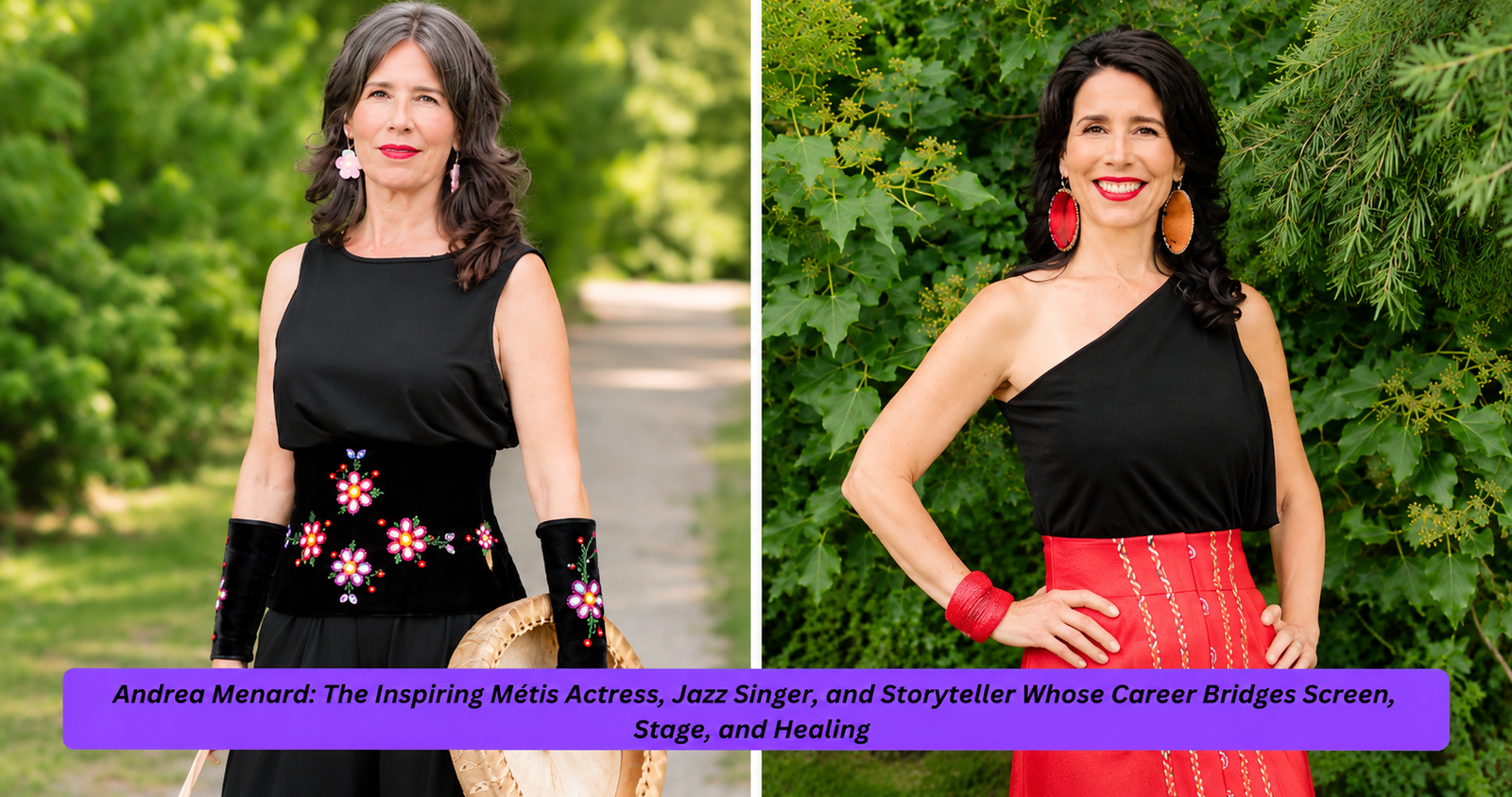
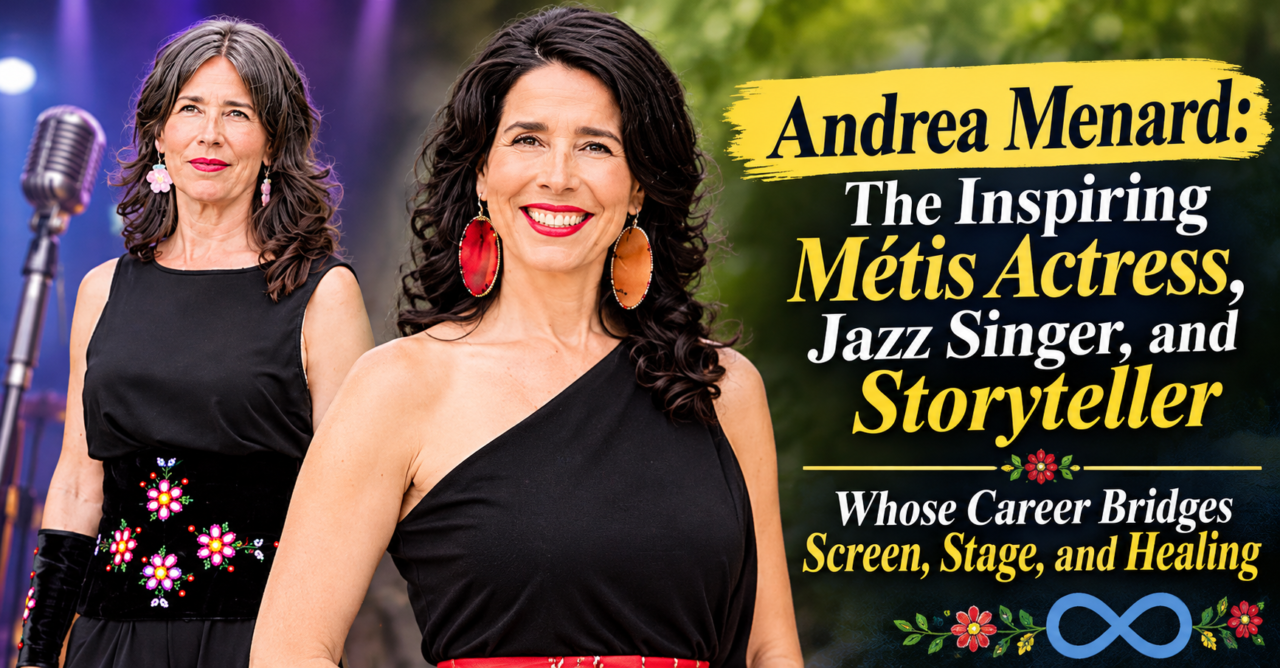
If you have ever watched Sullivan’s Crossing and found yourself smiling every time Auntie Edna walks into a scene, you have already met one of Canada’s most versatile performers. Behind that warm, wise character is Andrea Menard, a Métis actress, singer-songwriter, playwright, speaker, and author whose work spans television, theatre, jazz clubs, and wellness retreats. She is the kind of artist who refuses to be filed under a single label, and that refusal is a big part of her story.
This guide explains who she is, how her career unfolded, what she has built beyond acting, and why her voice matters in conversations about Indigenous storytelling in Canada. Instead of skimming a list of credits, you will get the context behind them: the roots that shaped her, the projects that defined each chapter, and the practical lessons her path offers to anyone building a creative life. Think of it as the long conversation you would have if you sat down with someone who had followed her work for years.
Who Is Andrea Menard? A Quick, Clear Answer
Andrea Menard is a Canadian Métis performer born in Flin Flon, Manitoba, in 1971, and best known as an actress, jazz and Indigenous-music singer-songwriter, playwright, and speaker. She rose to national attention through the television series Moccasin Flats, wrote and starred in the one-woman musical The Velvet Devil, and later appeared in Rabbit Fall, Blackstone, and Sullivan’s Crossing. She is also the founder of the Sacred Feminine Learning Lodge, a wellness and learning initiative.
That short definition covers the headlines, but it does not capture the shape of her career. Most performers pick a lane and stay in it. Menard describes herself as a blend of several callings, and she has built a working life that moves between a film set, a concert stage, a speaking podium, and a retreat circle without feeling forced. Her five Gemini nominations, her many music awards, and her recognition from ACTRA, Canada’s national union of performers, show that this range has been noticed and respected by the industry.
Early Life and Métis Roots
Andrea Menard was born in Flin Flon, a northern mining town in Manitoba, and her family roots trace back to St. Laurent, Manitoba, a historic Métis community. She later settled in Saskatchewan, where she has been based for much of her career, with Prince Albert often named as home in local coverage. Those prairie landscapes and Métis communities are not just background details. They run through her songs, her storytelling, and the way she talks about identity and belonging.
Growing up, she did not see a clear map from talent to career. In a conversation recorded for a Canadian speaker series, she explained that she was not even sure she had the option of choosing between acting and singing, and she thought she might simply teach drama because it was the most creative job she could imagine. That honesty is relatable. Many people with creative gifts spend years believing they must choose one path, and her early uncertainty is exactly what makes her later confidence so instructive.
The Velvet Devil: Where the Stage Career Took Off
Long before television made her a familiar face, Menard built her reputation in the theatre. She wrote and composed The Velvet Devil, a one-woman musical that opened to strong reviews in the late 1990s and showcased both her jazz vocals and her instinct for character. In the story, she plays Velvet Laurent, a singer whose journey blends music, memory, and reinvention. Writing, composing, and performing a full show alone is a demanding feat, and it announced that she was not just an interpreter of other people’s material but a creator in her own right.
The show later reached a wider audience through television, where versions appeared on CBC and APTN, the Aboriginal Peoples Television Network. That crossover matters for a practical reason. Many stage productions disappear once the run ends, but adapting the piece for broadcast let new viewers experience it and gave Indigenous-led storytelling a larger platform. For emerging artists, it is a useful case study: build a strong original work, perform it live, then look for ways to extend its life across other media.
Moccasin Flats and the Television Breakthrough
Many Canadians first came to know Andrea Menard through Moccasin Flats, the drama set in an inner-city Regina neighbourhood. She played Detective Amanda Strongeagle, a police officer with the Regina Police Service, across roughly 22 episodes between 2003 and 2006. The series was notable because it centred Indigenous characters and Indigenous creative voices at a time when mainstream television offered very few such stories, and it aired on networks including APTN.
Playing a police officer in a community that has a complicated history with policing is not a simple assignment, and the role gave Andrea Menard room to show nuance. A strong example of why this mattered is how the series let viewers see an Indigenous woman in a position of authority who was neither a stereotype nor a symbol. The role helped establish her as a dramatic actress, and it opened the door to the leading parts that followed. In the language of search and career alike, Moccasin Flats was the entry point that connected her name to a national audience.
Rabbit Fall, Blackstone, and Hard Rock Medical
After Moccasin Flats, her screen credits grew in range. She appeared in the children’s animated series Wapos Bay in 2005, took a leading role in the speculative drama Rabbit Fall, which ran from 2007 to 2008 on Space and APTN, and joined the cast of Blackstone, the hard-hitting series about a fictional First Nation community that gained a wider audience through Netflix. She also appeared in Hard Rock Medical in 2013. Each project asked for something different, from voice work to supernatural suspense to raw contemporary drama.
Her Gemini nominations reflect this variety. Those nominations, from the awards that were later folded into the Canadian Screen Awards, recognized her leading performances across several productions. Blackstone in particular is worth noting because it dealt with housing, governance, addiction, and corruption in a way few network dramas had attempted. Being part of that ensemble placed Menard inside a body of work that many critics and community members regard as an important chapter in Canadian television. For aspiring actors, the lesson is clear: choose projects that stretch you and say something, not just ones that pay the bills.
Sullivan’s Crossing and a New Audience
In recent years she has reached a much broader viewership through Sullivan’s Crossing, the CTV and CW series adapted from Robyn Carr’s novels. As Auntie Edna, she plays a grounded, loving presence who feels like the aunt every community wishes it had. The role arrived after decades of work, which is a reminder that a career can build slowly and then expand dramatically when the right part meets the right moment.
What stands out about Auntie Edna is how naturally the character fits what Andrea Menard brings offscreen. Her public talks and interviews emphasize care, community, and the wisdom of elders, and the character carries that spirit into a mainstream series. The result is a rare alignment between an actress’s values and her role. Viewers who discover her through the show often go looking for her earlier work, which sends them back to Moccasin Flats, her albums, and her speaking, and that ripple effect is how Andrea Menard has gained a new generation of followers.
Music: Jazz, Sparkle, and the Michif Album
Music has always been the other half of her public life. Andrea Menard is an accomplished jazz singer whose albums include Simple Steps in 2007, Sparkle in 2008, and Lift in 2014, and venues that present her work describe her as the creator of five significant albums known for narrative-driven healing and autobiographical reflection on Métis history and identity. In 2011 she also wrote a seventy-minute holiday special for APTN built around Sparkle, which aired for six seasons and brought her music into living rooms across the country.
After roughly a decade away from releasing albums, she returned with a project in Michif, the Métis language. Andrea Menard told Eagle Feather News that she worked with seven language keepers from Saskatchewan and Manitoba, and that she had to “sit with Elders and Language Keepers” to do the work properly. That detail says a lot about her approach. Rather than treating language as decoration, she treated it as a responsibility.
The album led to her being named Métis Artist of the Year at the Summer Solstice Indigenous Music Awards in Ottawa in 2023, and she has since developed a theatrical cabaret called Rubaboo, named for a Michif word for a hearty leftovers stew, that invites audiences into the richness of Métis culture.
Career Snapshot: Key Projects and Milestones
The table below organizes the most important chapters of her career so you can see how the stage, screen, music, and wellness work connect. Dates reflect widely reported public information and may vary slightly by source.
| Area | Project or Milestone | Approximate Period | Why It Matters |
|---|---|---|---|
| Theatre | The Velvet Devil (one-woman musical) | Late 1990s onward | Showed her skill as writer, composer, and performer |
| Television | Moccasin Flats (Detective Amanda Strongeagle) | 2003–2006 | National breakthrough in an Indigenous-led drama |
| Television | Wapos Bay (voice work) | 2005 | Brought her talent to family and children’s programming |
| Television | Rabbit Fall | 2007–2008 | Leading role in a genre series on Space and APTN |
| Music | Simple Steps, Sparkle | 2007–2008 | Established her as a recording artist |
| Television | Sparkle holiday special on APTN | 2011 onward | Original seasonal special that aired for six seasons |
| Television | Blackstone | 2010s | Ensemble role in a landmark Indigenous drama |
| Television | Hard Rock Medical | 2013 | Further proof of her dramatic range |
| Music | Lift | 2014 | Continued her autobiographical songwriting |
| Recognition | ACTRA National Woman of the Year | 2021 | Industry honour for leadership and impact |
| Music | Michif-language album and Métis Artist of the Year | 2023 | Language revitalization meets awards recognition |
| Television | Sullivan’s Crossing (Auntie Edna) | 2023 onward | Mainstream reach on CTV and The CW |
Looking at the timeline as a whole, a pattern emerges. She rarely abandons one discipline when she moves into another, and instead lets each feed the next. The stage show created the music, the music informed the television specials, and the screen work widened the audience for everything else.
The Sacred Feminine Learning Lodge and Her Speaking Work
Alongside performing, Andrea Menard has built a second career as a speaker, wellness trainer, and retreat host. She is the founder of the Sacred Feminine Learning Lodge, an initiative that helps participants reclaim and embody qualities associated with the sacred feminine, and she is the author of the Seeds from the Sacred Feminine Wisdom Cards, a deck designed to support new rituals of self-care and a gentler way of walking on the Earth. Andrea Menard also carries the name Skooteah Eqahh, which means Fire Woman in Anishinaabe, a detail that reflects how closely her creative and spiritual lives are intertwined.
Her TEDx talk, Silent No More, has reached more than 125,000 views, which is a notable figure for a talk rooted in Indigenous womanhood and voice. She is also an advocate for rematriation, a term used to describe returning Indigenous cultural and spiritual authority to women and to the land, and for reconciliation more broadly. Consider a practical scenario: a corporate or community group wants a speaker who can discuss reconciliation without lecturing. Andrea Menard fits that need because she combines lived experience, performance skill, and a teaching style built on storytelling rather than slogans.
Awards and Recognition
Her list of honours is long, though the numbers vary slightly between official biographies. Sources describe her as a five-time Gemini-nominated actress and a winner of fifteen or sixteen Canadian music awards, depending on when the biography was written. In 2021 she was named ACTRA National’s Woman of the Year, and in 2023 she won Métis Artist of the Year at the Summer Solstice Indigenous Music Awards. A venue profile also notes that she was recently named Métis Artist of the Year at the Saskatchewan Indigenous Music Awards in 2025.
What makes these honours meaningful is the range of institutions that offered them. A film and television union recognized her leadership, music organizations recognized her artistry, and Indigenous music awards recognized her cultural contribution. Her work has also been documented in an oral history interview held in the collection of the National Music Centre in Calgary, which signals that she is considered part of Canada’s musical record. When several independent organizations honour the same person for different reasons, it is a strong sign of genuine authority rather than a single lucky win.
Why Her Work Matters for Indigenous Representation
To understand why Andrea Menard resonates, it helps to look at the problem she and her peers set out to solve. For decades, Indigenous people appeared on Canadian screens rarely, and when they did, the portrayals were often narrow. The solution came from Indigenous-led production, supported by broadcasters such as APTN, and from performers who insisted on complexity. Moccasin Flats, Rabbit Fall, and Blackstone all pushed against old patterns by centring Indigenous characters with full inner lives.
Her work extends that effort beyond acting. Writing her own show, recording in Michif, and building a wellness practice grounded in Métis land-based teachings all treat Indigenous culture as living rather than historical. In the years since the Truth and Reconciliation Commission’s final report in 2015, institutions across Canada have asked how to move from acknowledgement to action. Artists like Menard offer one answer: create work that invites people into the culture rather than simply describing it from the outside.
Lessons From a Multi-Hyphenate Career
There is a practical takeaway in how she has managed her path. Early on, she was asked whether she was an actor or a singer, and she eventually reframed the question. Andrea Menard describes her identity through the medicine wheel, saying that as an Indigenous woman she has “to think of the circle” and does not have to pick just one part of herself. That idea, that creativity can be a wheel rather than a ladder, is a helpful antidote to the pressure many professionals feel to specialize narrowly.
Her career also shows the value of patience and course correction. Andrea Menard stepped back from releasing music for about a decade to focus on acting and wellness training, and when she returned, she came back with a project that was more personal and more purposeful than anything before it. For creators, freelancers, and entrepreneurs, that is a useful model. A pause is not a failure, and the work you return to after stepping away can be the best you have ever made.
Frequently Asked Questions About Andrea Menard
Who is Andrea Menard and what is she known for?
Andrea Menard is a Canadian Métis actress, jazz and Indigenous-music singer-songwriter, playwright, and speaker. She is best known for playing Detective Amanda Strongeagle in Moccasin Flats, starring in Rabbit Fall, appearing in Blackstone, and portraying Auntie Edna in Sullivan’s Crossing. She is also known for writing and performing The Velvet Devil and for founding the Sacred Feminine Learning Lodge.
Where was she born and where is she based?
She was born in Flin Flon, Manitoba, in 1971, and her family roots lead back to the Métis community of St. Laurent, Manitoba. She has been based in Saskatchewan for much of her career, and regional coverage often associates her with Prince Albert. Her upbringing and prairie connections inform much of her music and storytelling.
What awards has Andrea Menard won?
She is a five-time Gemini-nominated actress and has won more than fifteen Canadian music awards, according to official biographies. She was named ACTRA National’s Woman of the Year in 2021 and was honoured as Métis Artist of the Year at the Summer Solstice Indigenous Music Awards in 2023. Recent venue profiles also note a Métis Artist of the Year recognition at the 2025 Saskatchewan Indigenous Music Awards.
What is the Sacred Feminine Learning Lodge?
It is a learning and wellness initiative that she founded to help people of all genders reclaim and embody qualities associated with the sacred feminine. The work draws on Métis land-based practices and includes workshops, retreats, and the Seeds from the Sacred Feminine Wisdom Cards. It reflects her commitment to rematriation, reconciliation, and self-care rooted in Indigenous teachings.
Does she sing as well as act?
Yes, music is a core part of her identity. Andrea Menard is a jazz singer and songwriter whose albums include Simple Steps, Sparkle, and Lift, and she returned to recording with a Michif-language album after a break of about ten years. She has also created a theatrical cabaret called Rubaboo that celebrates Métis culture through song and story.
What is the best way to start exploring her work?
A good starting point is to watch Sullivan’s Crossing for her current screen presence, then move back to Moccasin Flats for her breakthrough dramatic work. After that, listen to her albums and watch her TEDx talk, Silent No More, to understand the ideas behind her wellness and advocacy work. Together, these give a well-rounded picture of her range.
Conclusion: Why Andrea Menard Still Matters
Looking across the stage, the screen, the recording studio, and the retreat circle, one thread connects everything she does: a commitment to telling Métis and Indigenous stories with warmth, honesty, and craft. From the late-1990s debut of The Velvet Devil to the national platform of Sullivan’s Crossing, from Gemini nominations to a Michif-language album built with Elders and language keepers, Andrea Menard has shown that a career can be broad without being scattered.
The final insight is simple and useful. Her path suggests that you do not have to choose a single identity to be taken seriously, and that depth often comes from letting different parts of yourself inform one another. Whether you are a fan, a student of Canadian media, or someone trying to build a creative life of your own, her story is a reminder that a circle can hold more than a straight line ever could.