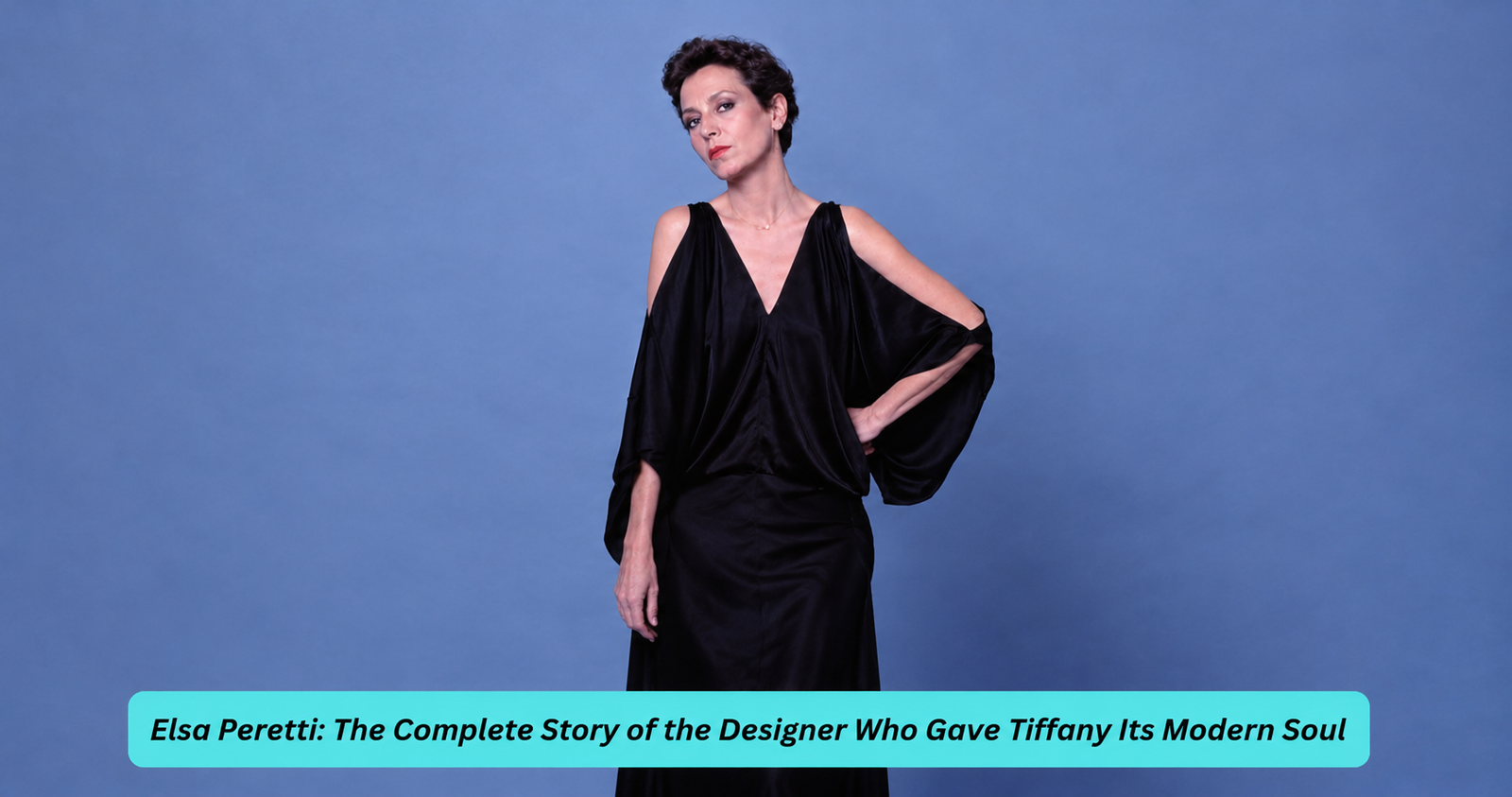
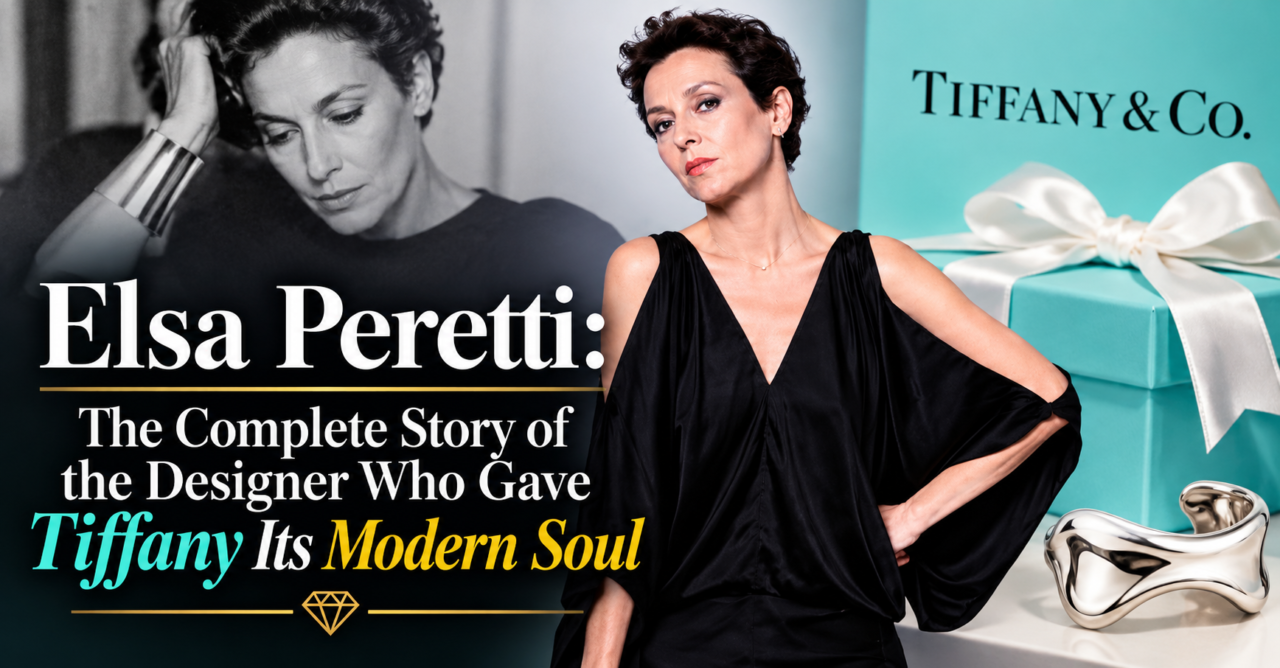
Walk into almost any Tiffany & Co. store and you will notice something curious. Beyond the famous robin’s-egg-blue boxes and the classic diamond solitaires, many of the pieces people actually reach for are soft, rounded, and almost pebble-like. They look like they were shaped by a river rather than a factory. Most of those pieces trace back to one woman, the Florence-born designer Elsa Peretti, whose sculptural, body-friendly jewelry reshaped what luxury could look like in the second half of the twentieth century.
This guide goes well beyond a simple biography. You will learn who she was, how a Roman-educated model became one of the most commercially important designers in Tiffany’s history, what made her pieces so different, and how her work continues to shape jewelry design today. Whether you are a collector, a fashion student, a gift buyer, or simply curious about the story behind that tiny Bean pendant, this article gives you the context, the details, and the practical advice to understand her legacy properly.
Who Was Elsa Peretti? A Quick, Clear Answer
Elsa Peretti (1940–2021) was an Italian jewelry and product designer best known for her long creative partnership with Tiffany & Co., which began in 1974. She created organic, sculptural designs inspired by the human body and nature, including the Bean, the Open Heart, the Bone cuff, and Diamonds by the Yard. Her work made fine design accessible by emphasizing sterling silver and simple forms rather than only heavy gemstones.
That definition is the short version, but it hides how unusual her career was. She was not trained as a goldsmith. She did not come up through a traditional atelier or apprenticeship. Instead, she approached jewelry the way a sculptor approaches clay, starting with how an object feels in the hand and against the skin, and only then thinking about price, stones, or prestige. That outsider mindset is exactly why her catalog feels so fresh decades later.
Early Life: From Florence to a Spanish Hilltop Village
Born in Florence in 1940 and raised in a well-off Italian family, Peretti grew up in a world where taste and craftsmanship were part of daily life. Her father was an industrialist, and her upbringing moved between Italy and Switzerland, including time at a Swiss boarding school and later studies in interior design in Rome. She was drawn to form and space long before she drew a single piece of jewelry, which is a detail worth remembering when you study her later work. Her pieces behave like tiny architecture.
In the 1960s she moved to Barcelona, where she worked as a model and absorbed the creative energy of the city’s artistic scene. Spain left a permanent mark. She eventually bought and restored a crumbling medieval house in the village of Sant Martí Vell, in Catalonia, and over the years she helped bring much of the old settlement back to life. Think of it as an early lesson in her method. She saw beauty in worn, imperfect things and believed in preserving what was authentic rather than replacing it with something shiny and new.
Arriving in New York and the Halston Connection
In 1968 she arrived in New York, a city that was about to become the global stage for American fashion. She worked as a model for designers including Halston and Giorgio di Sant’Angelo, and she quickly became part of the glamorous circle that gathered around Halston, the minimalist American couturier who dressed everyone from Jacqueline Kennedy to Liza Minnelli. She was a regular presence in the social world that included Andy Warhol, Studio 54 regulars, and the fashion press, and her friends included some of the most photographed people of the decade.
What made her stand out was not simply her connections but her instinct. Halston’s clothes were clean, fluid, and unfussy, and he needed jewelry that matched. Peretti began designing pieces for his runway shows, including a now-famous cuff shaped like a bone and delicate silver forms that echoed the body’s own curves. It was a classic problem–solution moment. Halston’s fashion needed accessories that did not fight the clothes, and Peretti provided jewelry that felt like part of the silhouette. Her success in that arena earned her a Coty Award in 1971, one of the major honors in American fashion at the time.
The Tiffany & Co. Partnership That Changed Luxury
In 1974, Tiffany & Co. began working with her, and the relationship would last for decades. At the time, Tiffany was admired but often seen as traditional, a temple of diamond rings and engraved silver. Bringing in a young designer from the Halston world was a bold move, and it paid off dramatically. Her first Tiffany pieces, including the Bean and Diamonds by the Yard, introduced a lighter, more modern attitude that appealed to women who wanted jewelry they could wear every single day, not only for galas.
The partnership eventually became one of the most lucrative designer collaborations in the history of fine jewelry. Her collection reportedly accounted for a significant share of Tiffany’s sales at its peak, and in 2012 the company signed a long-term renewal of the agreement, a sign of how central her designs had become to the brand’s identity. To put it plainly, Tiffany did not just sell her jewelry. It built a large part of its modern image around it. When you picture an approachable Tiffany gift under the tree or a graduation present in a blue box, you are very likely picturing a piece from the collection of Elsa Peretti.
Signature Designs: A Quick Reference Table
Her catalog is large, but a handful of pieces define her reputation. The table below summarizes the most influential designs, what inspired them, and why they matter in jewelry history.
| Design | Approximate Debut | Inspiration and Shape | Why It Matters |
|---|---|---|---|
| Bone Cuff | Early 1970s | The curved form of a bone, shaped to fit the wrist | Showed that jewelry could look like sculpture and feel like a second skin |
| Bean | 1974 | A smooth, rounded bean or seed shape | Became one of Tiffany’s most recognizable motifs and a modern classic gift |
| Diamonds by the Yard | 1974 | Single stones set at intervals along a delicate chain | Made diamonds feel casual and wearable every day |
| Open Heart | 1970s | A heart with a hollow center, pierced and flowing | Turned a sentimental symbol into a minimalist design icon |
| Mesh Collection | 1970s | Flexible woven metal that moves like fabric | Brought fashion-like drape into fine jewelry |
| Teardrop and Padova Pieces | 1970s onward | Soft, liquid shapes and gently domed forms | Reinforced her signature organic, pebble-like aesthetic |
Each of these designs solved a different problem. The Bone cuff solved the question of how a bracelet could feel sculptural without being heavy. The Bean solved the need for a small, meaningful gift that did not require a huge budget. Diamonds by the Yard solved the long-standing belief that diamonds were only for special occasions. Together, they built a collection that felt cohesive, even though it covered everything from earrings to tabletop objects.
Design Philosophy: Organic Forms and the Language of the Body
If you want to understand why her work endures, you have to understand her philosophy. She drew from nature constantly: beans, bones, tears, hearts, and the smooth pebbles you find at the water’s edge. These were not decorative details applied to a surface. They were the whole point. Her pieces have a tactile quality that invites touching, and many owners describe worrying them between their fingers the way you might hold a smooth stone in your pocket.
A useful analogy is the difference between a stage costume and a favorite sweater. A highly ornamented jewel announces itself from across the room. A piece by Elsa Peretti behaves more like that sweater. It is comfortable, personal, and gets better with time. This is why her designs often feel timeless rather than trendy, and why vintage pieces from the 1970s still look current when styled with modern clothing. Her approach was closer to industrial design and sculpture than to traditional high jewelry, and she carried that same sensibility into tableware, candle holders, and small objects for the home.
A typical scenario shows how this works in real life. Imagine a shopper standing at a jewelry counter, wavering between a flashy cocktail ring and a plain silver pendant. She might say, “I want something I will still reach for in ten years.” That sentiment, the desire for pieces with a long life rather than a short moment, is exactly what her designs were built to answer. The Bean is not asking to be admired. It simply wants to be worn.
Materials and Craftsmanship: Making Fine Design Accessible
One of the most important and often overlooked parts of her career is her embrace of sterling silver. In the 1970s, silver was frequently treated as a lesser material in fine jewelry, something for everyday trinkets rather than serious design. She challenged that assumption. By treating silver as a sculptural medium worthy of the same care as gold, she helped open the door for a broader audience to enjoy luxury craftsmanship without needing a diamond budget.
Of course, she also worked in gold, platinum, and gemstones, and her pieces were produced with exacting attention to finish. The smooth, polished surfaces, the weight distribution, and the way a clasp sits against the skin were all considered carefully. She was known to be demanding about details, which is part of why her designs feel so resolved. When you pick up a genuine piece, you notice that the edges are softened and the curves are consistent, because the design depends on perfection in simple forms. A complicated piece can hide flaws behind ornament. A smooth one cannot, which is why the craftsmanship behind Elsa Peretti pieces matters so much.
Business Impact: How One Designer Shaped a Luxury Brand
From a business perspective, her influence on Tiffany is hard to overstate. Before her arrival, the brand leaned heavily on bridal and high jewelry. Her collection introduced a new customer: the self-purchasing woman who wanted to buy herself something beautiful for a promotion, a birthday, or simply because. That shift mirrored larger cultural changes, as more women gained financial independence and expected luxury brands to speak to them directly.
It also helped Tiffany reach younger buyers at more accessible price points while keeping its prestige intact. A Bean pendant or Open Heart necklace functioned as an entry point to the brand, often becoming a customer’s first Tiffany purchase and the beginning of a long relationship. Marketing experts often describe this as a classic gateway product strategy. When LVMH completed its acquisition of Tiffany in early 2021, the enduring commercial strength of heritage collections like hers was part of what made the brand so attractive.
The Elsa Peretti Foundation and a Life of Giving
Her generosity extended well beyond design. In 2000, she established the Elsa Peretti Foundation, which supports a wide range of causes including humanitarian aid, medical research, the arts, and the preservation of cultural heritage. Much of her wealth and creative energy went into philanthropy, a fact that adds real depth to her public image. She was not simply a successful designer. She was someone who believed deeply in giving back.
The foundation’s work also connected to her personal passions. Her restoration of Sant Martí Vell, her support for artistic and cultural projects, and her backing of community initiatives all reflected a consistent worldview. She cared about beauty, but she also cared about people and places. For readers who value ethical storytelling in luxury, this is an important part of the picture. The Elsa Peretti Foundation continues to carry that mission forward, which means her influence reaches beyond the jewelry cases into real-world impact.
Legacy and Influence After 2021
She passed away in March 2021 at the age of eighty, shortly after the LVMH acquisition of Tiffany was finalized. Tributes poured in from the fashion and design worlds, and many commentators noted how rare it is for a single designer to create something that remains commercially vibrant and artistically respected for half a century. Her work is now studied in design programs and appears in discussions of twentieth-century modernism alongside better-known industrial designers.
Her influence is visible across the jewelry industry today. Minimalist silver collections, pebble-shaped pendants, and everyday diamond chains have become common, but many of these ideas were pioneered or popularized by her. Younger designers often cite her as a major reference point when discussing the movement toward wearable, understated luxury. Even people who have never heard her name wear her influence daily, which is perhaps the highest compliment a designer can receive. The legacy of Elsa Peretti is less about a single masterpiece and more about a design language that quietly became part of how we think about modern jewelry.
Buying, Authenticating, and Caring for Peretti Pieces
For collectors and shoppers, one practical challenge is that popularity brings imitation. Counterfeit versions of the Bean, Open Heart, and Diamonds by the Yard circulate widely, especially on resale marketplaces. The best solution is to buy from authorized sellers or reputable dealers who can verify provenance, and to examine hallmarks, weight, finish quality, and packaging carefully. Genuine pieces typically carry the Tiffany & Co. mark along with the designer’s name, the metal purity stamp, and consistently crisp lettering. Blurry engraving, uneven polishing, and unusually light weight are common warning signs.
Care is equally important. Sterling silver naturally develops a soft patina, and many collectors find that a little tarnish adds character, but regular gentle cleaning keeps pieces looking their best. A soft polishing cloth, mild soap, and warm water handle most routine needs, and storing items in a dry pouch slows tarnishing considerably. Avoid harsh chemicals and abrasive cleaners, which can scratch the smooth surfaces that define the design. If you own a vintage piece, consider having it checked by a professional jeweler occasionally, particularly the clasps and chain links, since regular wear can loosen them over time.
Frequently Asked Questions About Elsa Peretti
Who was Elsa Peretti and why is she famous?
She was an Italian designer born in Florence in 1940 who became one of the most influential figures in modern jewelry through her work with Tiffany & Co. She is famous for creating accessible, sculptural designs such as the Bean, the Open Heart, the Bone cuff, and Diamonds by the Yard. Her pieces reshaped Tiffany’s image and helped establish a softer, more organic style that still dominates everyday luxury jewelry.
What is the most famous design by Elsa Peretti?
Many people would point to the Bean, introduced in 1974, as her most recognizable creation because of its simplicity and wide appeal. Others argue that Diamonds by the Yard or the Open Heart pendant has reached equal fame. The honest answer is that the most iconic piece depends on the audience, but all of them share the same smooth, body-friendly character that defines her work.
Did Elsa Peretti design only for Tiffany & Co.?
Her most important and lasting work was for Tiffany, but she began her design career creating jewelry for Halston in New York and earned a Coty Award in 1971 before the Tiffany partnership started. She also designed tableware, home objects, and small sculptural items. Still, the Tiffany collaboration is where her influence became global, and it remains the heart of her reputation.
Is jewelry by Elsa Peretti still available?
Yes, Tiffany & Co. continues to offer collections inspired by her designs, and vintage pieces circulate on the resale market through dealers and auction houses. Because demand remains strong, collectors should be careful to verify authenticity when buying secondhand. Checking hallmarks, buying from reputable sellers, and requesting documentation are the best ways to protect yourself.
What was the Elsa Peretti Foundation?
The foundation was established in 2000 to support humanitarian, medical, artistic, and cultural causes. It reflects her belief in using success to help others and in preserving heritage, including projects tied to her beloved village in Catalonia. It stands as a reminder that her legacy includes generosity as well as design.
Why is her jewelry considered timeless?
Her designs rely on natural forms such as beans, hearts, and bones rather than seasonal trends, so they rarely look dated. The smooth surfaces and comfortable shapes also make them easy to wear every day and easy to pair with almost any outfit. That combination of simplicity and emotional resonance is why a piece bought decades ago can still feel perfectly current.
Conclusion: Why Elsa Peretti Still Matters
Looking back across her life, the thread that ties everything together is a simple conviction: beautiful things should feel good to live with. From the runways of Halston’s New York to the glass cases of Tiffany & Co., from a restored Catalan village to the philanthropic work of her foundation, she consistently chose authenticity over ornament and warmth over pretension. That philosophy turned a handful of humble shapes into global icons and changed how millions of people think about fine jewelry.
If you are exploring the world of design, collecting jewelry, or simply choosing a meaningful gift, the story of Elsa Peretti offers a powerful takeaway. Lasting luxury is rarely about being the loudest piece in the room. It is about creating something so honest, so natural, and so well made that it becomes part of someone’s life. That is the real secret behind her enduring influence, and it is a lesson that designers, brands, and shoppers can all carry forward.