Every few years, a new royal bride walks into a cathedral or chapel, and within minutes the internet starts asking the same question: does that dress remind you of Grace Kelly’s? The comparison comes up so reliably that it has become a kind of fashion reflex. The Grace Kelly wedding dress set a visual standard in 1956 that designers, brides and magazine editors are still measuring themselves against, seventy years later. It is that rare garment that functions as a costume, a piece of couture, a museum object and a cultural symbol all at once.
What makes the story more interesting than the usual “pretty gown” narrative is how much thought went into every decision. This was not a dress made for a Hollywood premiere, where flash wins. It was made for a Catholic cathedral, a live international television broadcast, a reigning prince’s family, and a woman who was about to trade a film career for a throne. Each seam had to answer to all of those audiences at once. This guide walks through the design, the materials, the people, the symbolism and the legacy, and it also flags the places where published sources disagree, because a good deal of the internet repeats numbers that do not quite line up.
What Is the Grace Kelly Wedding Dress and Why Does It Still Matter
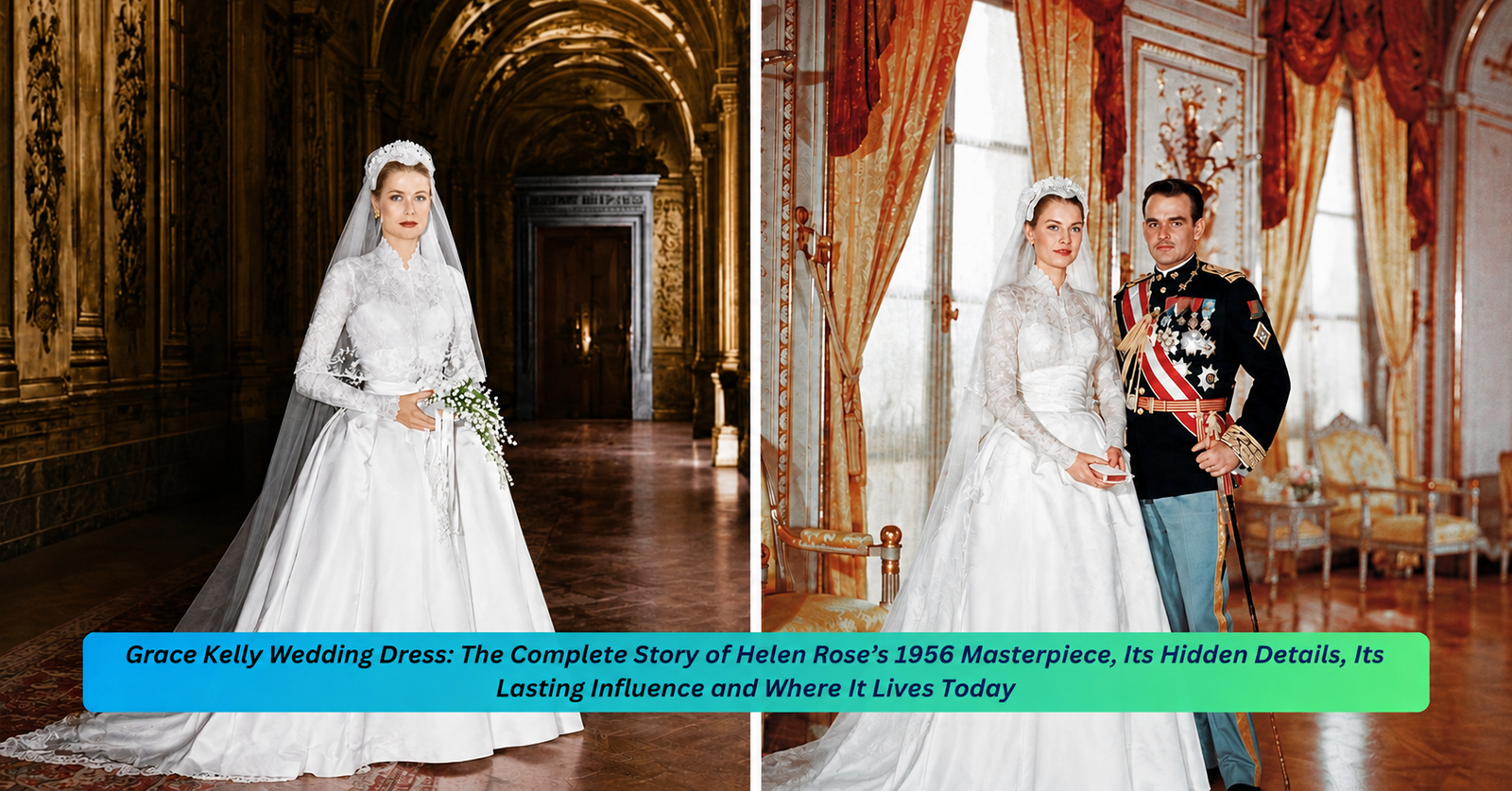
The Grace Kelly wedding dress is the ivory bridal gown the Oscar-winning actress wore to her religious wedding to Prince Rainier III of Monaco on April 19, 1956, at Saint Nicholas Cathedral. It was designed by Helen Rose, MGM’s costume designer, and given to Kelly as a gift by the studio. The look is defined by a high lace neckline, long lace sleeves, a fitted bodice, a pleated waist and a full bell-shaped skirt. In plain terms, it is the template most people picture when they hear the phrase “classic royal wedding dress.”
The reason it still matters is that it quietly redefined what a glamorous bride could look like. Before 1956, Hollywood glamour usually meant bare shoulders, plunging necklines and shimmering satin. Kelly’s gown went in the opposite direction, covering the arms, collar and shoulders in antique lace, and it looked more luxurious for it. That choice turned modesty into an aesthetic statement, and the idea has been recycled by bridal designers ever since. Fashion historians often describe it as a case of restraint reading as power, which is also why the gown dates so slowly.
The Road to the Altar: Grace Kelly, Prince Rainier and the Monaco Wedding of 1956
The story begins at the Cannes Film Festival in 1955, where Kelly was promoting Alfred Hitchcock’s To Catch a Thief. She was introduced to Prince Rainier at his palace, and although it was not love at first sight, he began a long correspondence with her that led to marriage. Their engagement was announced in January 1956, when Kelly was 26 and the prince was 32. The courtship was short by royal standards, and the wedding followed only a few months later.
Because Monaco follows a civil-first tradition similar to France, the couple actually married twice. The civil ceremony took place in the palace throne room on April 18, 1956, and the religious ceremony followed at Saint Nicholas Cathedral on April 19. Roughly 30 million viewers are reported to have watched the church wedding on television, which is why it became known as a media event as much as a royal one. About 1,500 journalists were reported to have covered the celebrations. Guest counts for the cathedral vary between roughly 600 and 700 depending on the source, and the guest list included stars such as Cary Grant and Ava Gardner as well as Aristotle Onassis.
For Monaco, the wedding was also a strategic moment. The principality gained international attention, glamour and soft power that casino revenue alone could not buy, and Kelly’s image as an elegant, reserved American bride became the face of that new identity. The dress was the visual centerpiece of the entire operation, which explains why it was guarded so carefully. According to the Philadelphia Museum of Art, the gown was kept under strict security in MGM’s wardrobe department before the wedding.
Helen Rose: The Costume Designer Behind the Gown
Helen Rose was not a traditional bridal couturier. She was a two-time Academy Award-winning costume designer who spent years dressing MGM’s biggest stars, and she had already designed for Kelly in films such as The Swan and High Society. MGM executives had earlier gifted Elizabeth Taylor a Helen Rose original for her 1950 wedding to Nicky Hilton, so the studio was clearly in the habit of using Rose for its stars’ biggest personal moments. That familiarity mattered. Rose knew Kelly’s proportions, her posture and the way she moved in front of a camera.
Rose later described the experience in warm terms. She called Kelly a dream to work with and said Kelly simply picked her favorite from two final sketches. That anecdote says a lot about the working relationship: decisive client, trusted designer, almost no friction. It also explains why the finished gown feels so cohesive. There was no committee diluting the concept, and no attempt to make the dress do more than one thing well.
Think of it like a film costume designed for the longest close-up of a career. Rose understood that a wedding gown on live television has to read clearly from a distance, hold its structure during movement, and flatter the face without competing with it. Those are costume-design instincts, and they are a large part of why this gown photographs better than many couture dresses made by pure bridal houses.
Anatomy of the Gown: Lace, Silk, Pearls and Four-Part Construction
On the surface, the dress looks simple: lace on top, a full skirt on the bottom. Underneath, it is surprisingly complex. The Philadelphia Museum of Art notes that it is constructed in four complex parts, including a lace bodice with an underbodice and a silk faille skirt. The dress also included a slip and a pleated silk faille cummerbund, which gave the waist its crisp, sculpted line. That modular construction let the gown hold its shape through hours of ceremony without wrinkling or sagging.
The bodice is the most talked-about element. It was made of antique Brussels lace that was re-embroidered and accented with seed pearls. Some sources describe the lace as about 125 years old, which would date it to the 1830s. Rose point lace and seed pearls traced the hem, while the veil was left unadorned over Kelly’s face so the veil would not hide her. The balance between ornament and negative space is one of the quietest design decisions in the whole outfit.
The table below summarizes the key components, with a note on where reports differ.
| Component | Material and detail | Notes on sources |
|---|---|---|
| Bodice and sleeves | Antique Brussels or rose point lace over silk net, with a high collar | Lace age is often cited as around 125 years |
| Skirt | Silk taffeta or silk faille, full and bell-shaped, worn over petticoats | Sources vary between taffeta and faille wording |
| Waist | Pleated silk faille cummerbund | Documented by the Philadelphia Museum of Art |
| Embellishment | Thousands of hand-sewn seed pearls | Pearls also appear on the veil, shoes and prayer book |
| Labor | Roughly 30 to 36 seamstresses over about six weeks | Counts vary between reports |
| Fabric quantity | Hundreds of yards of lace, silk and tulle in total | Yardage figures differ widely across publications |
The pearls started a theme that carried through the shoes, prayer book, headpiece and veil. That is a subtle but important design principle: a single motif repeated across every accessory so the whole look feels like one idea instead of a collection of expensive parts.
The Accessories: Juliet Cap, Veil, Prayer Book and Shoes
If the dress was the headline, the accessories were the supporting argument. Instead of a tiara, Kelly chose a Juliet cap made with the same Belgian lace used on her gown. The cap was decorated with pearls, wax orange blossoms and floral lace motifs, and it sat over a simple tulle veil. Skipping the tiara was a noticeable choice for a woman about to become a princess, and it kept the look soft and personal rather than imperial.
The veil deserves its own attention. It is often described as a circular tulle veil measuring about 90 yards of fabric. Its edges were stitched to feature two lovebirds, a small romantic detail that most viewers watching on television would never have noticed. Her bouquet was lilies of the valley, and she carried a small prayer book. The book was embellished with silk, lace and pearls to match the gown. Her shoes were designed by David Evins and combined silk needle lace, silk faille,
seed pearls and glass beads. Seen together, the accessories show how much planning went into coordinating texture. Everything in the ensemble shares the same palette of ivory, cream and pearl, which is why the photographs feel so unified even decades later.
The Civil Ceremony Dress: The Other Gown Almost Everyone Forgets
Most articles about the bridal look stop at the cathedral gown, but Kelly wore a second Helen Rose design the day before. For the civil ceremony she wore a fitted pale pink taffeta dress with a flared skirt covered in cream lace. The ensemble was paired with white gloves and a Juliet cap. It was elegant and deliberately more subdued, which suited the smaller, legal nature of the event.
Compared with the Grace Kelly wedding dress worn in the cathedral, the civil outfit is a useful lesson in occasion dressing. The pink-and-champagne palette felt less formal and more modern, and it would translate easily to a contemporary courthouse or registry wedding. Brides planning two-part celebrations, a civil signing plus a larger ceremony, often use this pairing as a reference because it shows how to scale formality without losing the thread of the design.
Secrets, Symbolism and Small Details Hidden in the Design
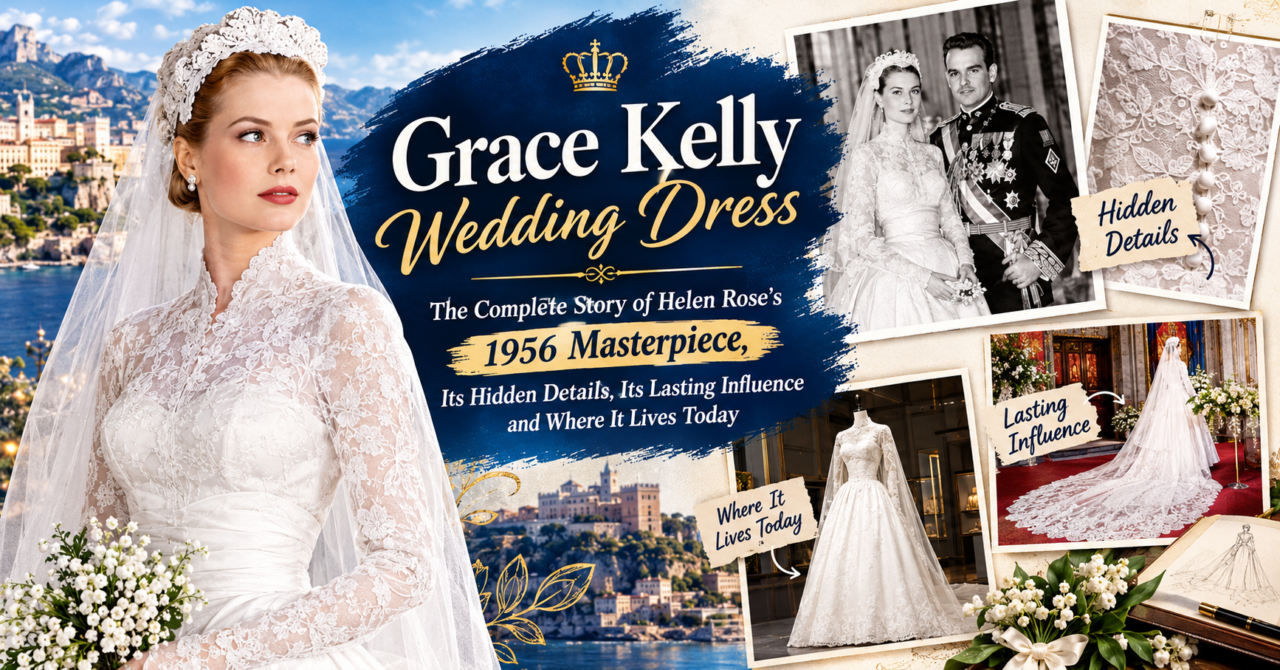
Some of the most charming facts about the gown are tiny ones. Rose added small blue bows down the back of the skirt as Kelly’s “something blue.” The designer also believed the back of the dress should be a focal point, because guests spend the ceremony looking at the bride from behind. That is a very practical insight, and it explains the careful detailing across the back of the bodice and train.
Then there is the lucky penny. In 2005, the Philadelphia Museum of Art discovered that Kelly’s wedding shoes held a lucky penny hidden in the right shoe. It is the kind of detail that makes a historical object feel human, a reminder that even the most scrutinized bride of her era was quietly hoping for good luck.
There is also a story about secrecy. Kelly told Paris Match she would not show the dress to Rainier until the wedding day, to keep it as a surprise. The public was kept in the dark as well, which amplified the anticipation and turned the reveal into a genuine media moment.
How the Grace Kelly Wedding Dress Solved Three Design Problems
It helps to look at the gown as a problem-solving exercise. The first problem was religious expectation. A Catholic cathedral wedding in 1956 called for covered shoulders and arms, and a high neckline with long sleeves satisfied that without feeling austere. Rose solved it with lace, which let the skin show through softly rather than hiding behind heavy fabric.
The second problem was the camera. Early television and press photography flattened detail, so the design relied on strong shapes and clear contrast: a fitted bodice, a defined waist and a dramatic skirt. The veil was designed so that it would not obscure the famous face, which was, after all, the thing millions of people were tuning in to see.
The third problem was symbolism. An American actress was marrying into European royalty, and the dress had to honor both worlds. Antique lace and pearls spoke to heritage and tradition, while the clean lines and understated styling kept her recognizably modern. Oscar de la Renta captured the effect well when he said her wedding look gave new meaning to the word icon. The solution worked because it did not choose between glamour and dignity; it fused them.
Influence on Bridal Fashion: From Kate Middleton to Miranda Kerr
The Grace Kelly wedding dress is probably the most frequently referenced royal bridal gown outside of Princess Diana’s. Its long sleeves, high neckline and lace-and-silk silhouette have served as a blueprint for brides including Kate Middleton, Miranda Kerr and Paris Hilton. The Knot also links it to Billie Eilish’s 2021 Oscar de la Renta Met Gala gown. That range, from royalty to supermodels to pop stars, shows how adaptable the silhouette is.
The most famous comparison is Catherine Middleton’s 2011 gown by Sarah Burton for Alexander McQueen. Both dresses shared a high lace collar, long lace sleeves and a full skirt. The two are not identical, and Burton’s design had its own floral appliqué and train, but the visual lineage is unmistakable. Commentators spotted the echo within minutes of the first photographs.
The deeper influence is conceptual. After 1956, “elegant” in bridal fashion began to include sleeves, structure and restraint. Designers still lean on that logic when they create modest, lace-forward gowns for brides who want something refined rather than revealing. In that sense, the dress changed not just what brides wore but what the industry believed brides wanted.
Where the Dress Is Today: Philadelphia Museum of Art and the Question of Value
After the wedding, Kelly donated the gown and several accessories to her hometown museum. The Philadelphia Museum of Art received the gown, cap, veil, shoes and prayer book shortly after the ceremony. In 2006, to mark the fiftieth anniversary, the museum staged an exhibition called “Fit for a Princess,” which it reported to have been arguably its most popular display. The exhibition was curated by H. Kristina Haugland, who also wrote the accompanying book, Grace Kelly: Icon of Style to Royal Bride.
Value is a more speculative topic. InStyle has cited an estimated modern value of about $623,000, compared with roughly $1.6 million for Queen Elizabeth II’s 1947 gown. The Knot puts Princess Diana’s gown at about $127,000 in 1981, roughly $490,000 in today’s money. These numbers are estimates rather than appraisals, and they should be read as rough comparisons, not auction figures. The dress is part of a museum collection and is not for sale.
If you want to see it in person, check the museum’s current gallery schedule first. Costume and textile pieces are often rotated off display to protect the fabric from light exposure, and older articles about where it is “currently” shown can be out of date.
How to Borrow From the Grace Kelly Wedding Dress Without Looking Costumey
Brides who love the look often worry about appearing like they are in costume. The trick is to borrow the principles, not the replica. Start with the high neckline or a sheer lace yoke, then add long sleeves in a fine lace rather than a heavy one. Keep the waist defined, and let the skirt do the dramatic work rather than piling on embellishment everywhere.
Fabric choice matters more than most people expect. Crisp taffeta or faille holds a skirt shape in a way that soft crepe never will, while a delicate tulle overlay keeps the look romantic rather than stiff. If you want a modern take, swap the full ball skirt for a softer A-line, or trade the Juliet cap for a clean, simple veil. A single motif, such as pearls repeated across a headpiece, belt and shoes, mimics the cohesive effect that made the original so convincing. A Grace Kelly wedding dress reference works best when you can describe it in three words, such as lace, structure and restraint, and then let a skilled seamstress interpret them.
Common Myths and Conflicting Numbers Around the Famous Gown
A lot of the web repeats numbers about this gown without checking them, and the figures do not always match. Seamstress counts range from “more than 30” to 36 depending on the publication. Fabric yardage ranges from hundreds of yards to over 400 in different write-ups, partly because some count the veil and petticoats and others do not. Guest counts for the cathedral appear as 600 in some sources and 700 in others, and viewership is most often given as 30 million, although at least one outlet states 300 million.
The most reliable details tend to come from the Philadelphia Museum of Art, which holds the physical garment and has documented its construction. When you see precise-looking figures from other sites, treat them as approximate unless they cite the museum, a book or a primary account. Being upfront about that uncertainty is not a weakness; it is how you separate verified fashion history from internet folklore.
Another common myth is that the whole wedding was a single ceremony. As covered above, there were two, and Kelly wore a different Helen Rose design for each. Skipping that detail flattens the story and misses a useful contrast between the civil and religious looks.
Frequently Asked Questions
Who designed the Grace Kelly wedding dress?
Helen Rose, the Academy Award-winning costume designer at MGM, designed it. She had previously dressed Kelly in several films, and the gown was a gift from the studio to its star. Rose also designed the pale pink lace dress Kelly wore to the civil ceremony the day before.
What was the Grace Kelly wedding dress made of?
It combined antique Brussels or rose point lace, silk net, silk taffeta or faille and tulle, with thousands of hand-sewn seed pearls. The Philadelphia Museum of Art describes a four-part construction that includes a lace bodice with an underbodice, a silk faille skirt, a slip and a pleated cummerbund. Exact fabric yardage differs between sources, so treat the numbers as approximate.
Where is Grace Kelly’s wedding dress now?
It belongs to the Philadelphia Museum of Art, which received it as a donation from Kelly shortly after the wedding. It has been shown in special exhibitions, including the 2006 “Fit for a Princess” display, but costume pieces rotate in and out of view, so it is worth checking the museum before planning a visit.
How much is the Grace Kelly wedding dress worth today?
One widely cited estimate is about $623,000, according to InStyle, which would place it among the most valuable wedding dresses in history. That figure is an estimate, not a formal appraisal, and the gown is a museum object that is not for sale.
Did Kate Middleton copy the Grace Kelly wedding dress?
Not exactly. Catherine Middleton’s 2011 Alexander McQueen gown by Sarah Burton shares the high lace collar, long lace sleeves and full skirt, which led many commentators to draw comparisons. It also has its own floral appliqué, a distinct train and a different construction, so it is better described as inspired by the tradition than as a copy.
Why was the Grace Kelly wedding dress so influential?
It showed that modesty could look glamorous and that a bride could feel regal without wearing a tiara or revealing clothing. The design suited a cathedral, a television audience and a royal family at the same time, which made it easy for later designers to adapt.
Conclusion
The Grace Kelly wedding dress endures because it solved a difficult design brief with unusual clarity. It had to satisfy a cathedral, a camera, a prince and a global audience, and it did all of that through lace, pearls, structure and restraint rather than excess. Helen Rose and Kelly understood that the most memorable bridal looks do not shout; they give the viewer a few perfectly judged details and trust the silhouette to carry the rest.
Seventy years on, the gown still shapes how people talk about royal fashion, from Kate Middleton to red-carpet homages. The final takeaway is simple: the lasting power of a wedding dress comes less from how expensive it is and more from how clearly it tells a story. In 1956, that story was of an American actress becoming a princess, told entirely through fabric