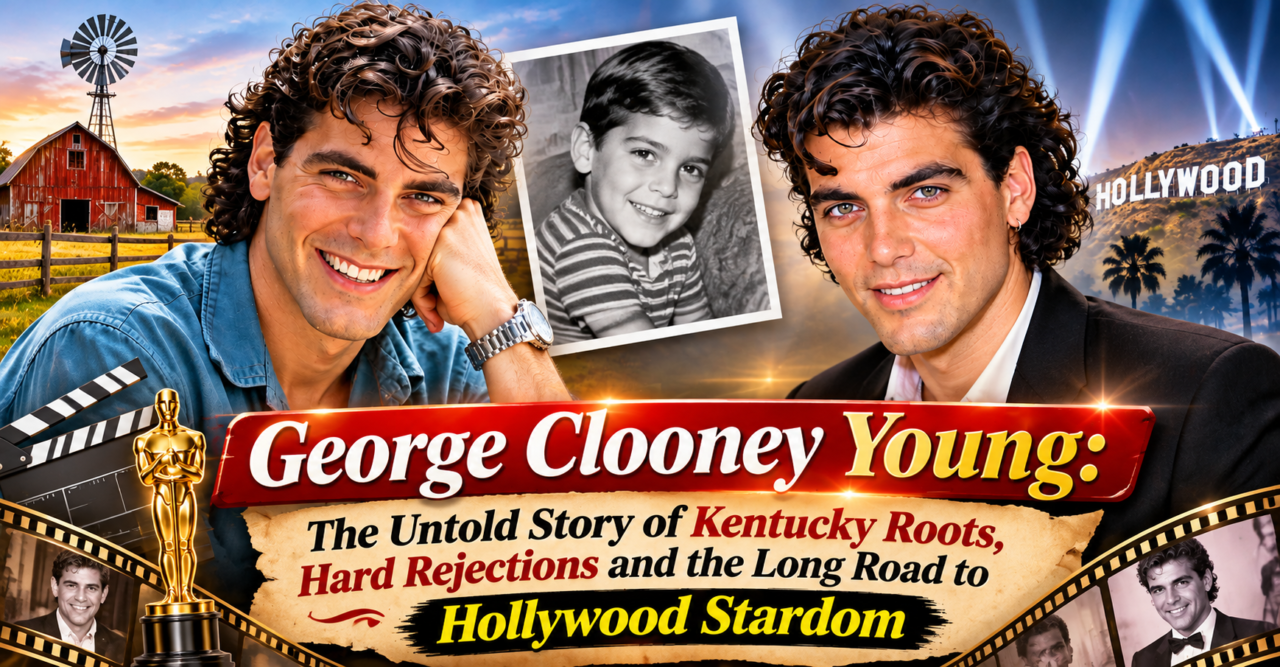
Before the Oscars, the humanitarian work and the silver-fox reputation, there was a Kentucky teenager who wanted to play professional baseball. The story of George Clooney young is far more interesting than the polished movie-star image suggests, because it is really a story about failure, patience and a stubborn refusal to be defined by famous relatives.
Most people meet Clooney as the finished product: the charming leading man of Ocean’s Eleven, the director of Good Night, and Good Luck, the Oscar winner. What they rarely see is the long apprenticeship that came first. He spent more than a decade bouncing between forgettable sitcoms, short-lived series and cancelled pilots, often sleeping on other people’s couches while he waited for something to stick.
This guide walks through his early life and career in order, from childhood in Kentucky and Ohio, through a frightening health scare, odd jobs and a failed baseball tryout, to the television roles that finally led to ER. The details come from established biographical references, news archives, his own interviews and accounts from family members and co-stars, so you can trust the timeline and understand why each stage mattered.
George Clooney Young: A Quick Answer About the Early Years
In short, George Timothy Clooney was born on 6 May 1961 in Lexington, Kentucky, and grew up mostly in the small Ohio River town of Augusta. He tried and failed to make it as a baseball player, moved to Los Angeles at 21 and spent roughly a dozen years in modest television work before the medical drama ER made him a star in 1994. That is the snapshot behind most searches for George Clooney young.
The reason those years deserve attention is that they explain the person who emerged later. Clooney did not arrive in Hollywood as an overnight sensation. He arrived as a working-class-adjacent kid from a famous family who had to prove he was more than a relative, and the habits he built during that time, including persistence, humour about himself and a skeptical attitude towards fame, show up in nearly every career decision he made afterwards.
Think of it like an athlete who spends years in the minor leagues. The public only sees the championship, but the quality of the training years determines whether the player survives the pressure of the big stage. Clooney’s apprenticeship was long, sometimes humiliating and ultimately formative.
Growing Up in Kentucky and Ohio: The Roots of a Future Star
Clooney was born into a family with deep ties to broadcasting and entertainment. His father, Nick Clooney, was a television news anchor and host, and his mother, Nina Bruce Warren, was a former beauty queen who later served as a city councilwoman. His aunt, Rosemary Clooney, was a celebrated singer and actress, and his cousin Miguel Ferrer would become a well-known actor. He also has an older sister, Adelia, known as Ada.
Because Nick’s work moved the family around, the childhood was far from settled. By second grade the Clooneys had left Lexington and settled in Columbus, Ohio, and George attended several schools in Ohio over the following years, including St. Michael’s in Worthington, Western Row Elementary in Mason and St. Susanna School, where he served as an altar boy. The family returned to Kentucky around the middle of his seventh-grade year, and in 1974 they settled in a large old Victorian house in Augusta.
Looking at the George Clooney young years in Kentucky, you can see the early signs of a performer. Nick Clooney has told the story of a toddler who, after a bout of laryngitis, ran to his mother and announced, “I’m having audio difficulties.” It is a tiny anecdote, but it captures the mix of comedy and drama that would later define his screen persona. Augusta itself, a modest town where everybody knew everybody, also helped keep him grounded despite the family’s name recognition.
Bell’s Palsy, Awkward Years and the Grit It Built
In middle school, Clooney developed Bell’s palsy, a condition that partially paralyzes the face. For roughly nine months, half of his face did not move normally, and he has described the recovery period as one that eventually passed without lasting damage. His father later acknowledged that the experience certainly affected his son at the time, particularly during the already vulnerable early teenage years.
Clooney himself has been candid about how difficult it was. He has said, “I was mocked and taunted, but the experience made me stronger.” That perspective is worth dwelling on, because it reframes an embarrassing period as a source of character. A teenager who spends months being teased about his appearance either withdraws or learns to laugh first, and Clooney clearly chose the second route, which helps explain his lifelong habit of aiming practical jokes at himself.
The problem-solution lesson here is simple and surprisingly practical. The problem was social humiliation during a sensitive stage of development. The solution, in his case, was humour, resilience and an increasingly self-deprecating style that later made him unusually likable on talk shows and film sets. Anyone dealing with a setback that feels visible and embarrassing can borrow the same strategy: take ownership of the story before others write it for you.
Baseball Dreams, Odd Jobs and the Centennial Extra Gig
At Augusta High School, Clooney was a strong student, reportedly earning all As and a single B, and he played both baseball and basketball. He has recalled that as a teenager he saw himself as a future baseball player, once saying he could catch anything and was a great outfielder in high school. He graduated in 1979 and later tried out for the Cincinnati Reds, but the team did not offer him a contract.
Acting was not an obvious next step. He attended both Northern Kentucky University and the University of Cincinnati without graduating from either, and he took a string of unglamorous jobs, including selling women’s shoes, working construction and cutting tobacco. Those jobs may sound like trivia, yet they gave him an unusually broad understanding of how ordinary people work, which later informed the grounded, everyman quality in roles such as the title character in Michael Clayton.
His first screen appearance came in 1978, when he worked as an extra on the television miniseries Centennial, which was partly filmed in his hometown. Later, his cousin Miguel Ferrer helped him get a small role on a feature film being shot in Kentucky, where George hung around the set for months as an extra and earned a few lines. It was a low-stakes introduction, but it gave him his first taste of a professional set.
Los Angeles at 21: Couches, Rejection and Rosemary’s Spare Room
At 21, Clooney moved to Los Angeles to pursue acting seriously. He stayed first with his aunt Rosemary, then moved in with his friend, actor Thom Mathews, with whom he lived for around eight months. The George Clooney young story in Los Angeles is not a glamorous tale of overnight discovery; it is one of auditions, rejections and borrowed furniture.
He has explained his motivation plainly: he could not accept the idea of “just being Nick Clooney and Rosemary Clooney’s relative” for the rest of his life. That drive to separate himself from his family name is a vital part of the story. Having famous relatives opens some doors but also creates enormous pressure to avoid looking like a beneficiary of nepotism, and Clooney responded by taking whatever work he could find.
His father, a veteran broadcaster, had advised him not to become an actor, pointing out that thousands of people make a living in broadcasting while only a small fraction of actors do. It was practical advice, and the father later joked that the moral of the story is to always listen to your father. Clooney ignored the warning, which in hindsight turned out to be one of the most consequential decisions of his life.
The Sitcom Years: Facts of Life, Roseanne and the Pretty-Face Problem
His first significant television role was in the short-lived CBS sitcom E/R in 1984, where he played a character named Ace. Not to be confused with the later NBC drama, it was a small step but a real one. Over the next several years he picked up recurring roles that kept him employed without making him famous: George Burnett, the handyman on The Facts of Life from 1985 to 1987, Booker Brooks on Roseanne from 1988 to 1991, and parts in Bodies of Evidence and Sisters in the early 1990s.
The challenge was that these roles leaned heavily on his looks. Years later he told the Washington Post, “Quite honestly, I was objectified,” recalling scenes where he would drop a clipboard on Roseanne and the cast would slap him as he bent over. He said he had to establish himself as more than that, and credited Good Night, and Good Luck with finally doing so. It is a remarkably frank admission from someone often described as a heartthrob.
The problem was typecasting as the handsome supporting guy. The solution, which took years, was to move behind the camera and choose projects that demanded range. That pivot toward directing, producing and politically engaged storytelling began as a response to the frustrations of his sitcom years, and it explains why his later filmography looks so deliberate compared with many actors of his generation.
A Timeline of the Early Years at a Glance
The table below distills the George Clooney young timeline into the milestones that mattered most.
| Period | Milestone | Why it mattered |
|---|---|---|
| 1961 | Born in Lexington, Kentucky | Entered a family steeped in broadcasting and entertainment |
| Mid-1970s | Settles in Augusta, Kentucky | Small-town upbringing that shaped his grounded personality |
| Middle school | Develops Bell’s palsy, recovers within a year | Built resilience and self-deprecating humour |
| 1978 | Appears as an extra in Centennial | First screen exposure, filmed in his hometown |
| 1979 | Graduates from Augusta High School | Strong grades, sports and a baseball dream |
| Early 1980s | Cincinnati Reds tryout fails; moves to Los Angeles at 21 | Baseball door closes, acting door opens |
| 1984 | Cast in the sitcom E/R | First notable television role |
| 1985–1991 | The Facts of Life and Roseanne | Steady work, but typecast by his looks |
| 1992–1994 | Bodies of Evidence and Sisters | Increasing profile, still no breakout |
| 1994 | Cast as Dr. Doug Ross on ER | Breakthrough that launched a film career |
What stands out in this timeline is the sheer length of the middle section. From the first LA roles to ER is roughly a decade, which means Clooney was in his mid-thirties when stardom arrived. That is considerably later than the popular image of a young heartthrob suggests, and it is a useful reminder that overnight success often takes ten years.
Thirteen Pilots and Seven Series: Learning to Fail Forward
One of the most revealing statements Clooney has made about this era is that he had already done “13 television pilots and seven series before ER.” Pilots that never became shows and series that were cancelled quickly are a kind of hidden failure that audiences never see. Each one involves auditions, rehearsals, hope and then disappointment, repeated over and over.
He has argued that this history left him better prepared for success. In his words, failing a lot meant he was a little more prepared in life for what happened next. That perspective is the opposite of the typical overnight-sensation narrative, and it explains why he has long seemed comfortable with fame: he had already learned that careers rise and fall and that no single role defines a person.
Consider the use-case scenario of a young professional in any field. Someone who has been laid off twice, passed over for promotions and watched projects collapse often handles a major opportunity with more calm than someone who has only known smooth progress. Clooney’s early failures worked the same way, turning potential panic into perspective.
ER and the Moment Everything Changed
In 1994, Clooney was cast as Dr. Doug Ross, a charming pediatrician with a complicated moral compass, on NBC’s ER, alongside Anthony Edwards, Noah Wyle and Julianna Margulies. The show became a massive hit, and Clooney earned three Golden Globe nominations and two Emmy nominations for his work as Ross. After years of recurring supporting roles, he finally had a stable, high-profile lead.
The ER years also showed early signs of the activist and producer he would become. In 1997, he noticed that TV Guide kept putting the show’s white actors on its covers while ignoring the Black cast members, and he pushed the magazine to change course. Co-star Eriq La Salle later said, “George really mounted a campaign,” and Noah Wyle joked that the cast learned the power of George’s pen. It was a small episode, but it signalled that he intended to use his influence.
While still on the show he also took film roles, including From Dusk Till Dawn and One Fine Day in 1996, and he left the series in 1999, though he returned for the finale. The move to film eventually led to O Brother, Where Art Thou?, an Oscar for his supporting work in Syriana in 2005, and a long career as an actor, director and producer. The foundation, however, was the decade he spent learning the craft in much less glamorous conditions.
Why George Clooney Young Photos and Stories Still Attract Readers
There is a reason people keep searching for George Clooney young photos, interviews and anecdotes. Part of it is simple nostalgia for the 1990s, when ER dominated television and Clooney became a pop-culture fixture. Part of it is curiosity about how a man who now projects effortless confidence started out as an unknown extra and a struggling actor.
There is also a deeper appeal. Stories about George Clooney young resonate because they show that even someone who now seems untouchable once worried about rent, rejection and whether he would ever be taken seriously. For readers who feel stuck in their own careers, the early Clooney is more relatable than the later one, and that relatability is a major reason these stories continue to circulate.
From an entity perspective, the topic connects to a cluster of related names and works: Nick Clooney, Rosemary Clooney, Miguel Ferrer, Augusta, Kentucky, The Facts of Life, Roseanne, ER, Doug Ross, and later projects such as Syriana, Michael Clayton and Good Night, and Good Luck. Understanding how these pieces connect gives a fuller picture than any single photo or headline can.
Lessons From the Early Years: Problems and Solutions
The practical lessons from the George Clooney young era are surprisingly applicable beyond Hollywood. The first problem was living in the shadow of a famous family. His solution was to build an identity through work rather than lineage, accepting small roles and earning each step. If you are trying to escape a label, proving yourself in public and over time is more effective than arguing against it.
The second problem was typecasting. Early roles reduced him to a handsome face, and he later acknowledged that this left him feeling objectified. The solution was to take creative control by producing and directing projects that showcased range, which gradually changed how audiences and the industry saw him. That strategy of broadening your skill set instead of waiting for permission is useful in any profession.
The third problem was sheer repetition of failure. Thirteen pilots and seven series is a daunting amount of rejection, yet he treated each one as practice. The solution was a mix of humour, persistence and perspective, and the payoff came when ER arrived at precisely the moment he was prepared to make the most of it. The takeaway is that resilience is not a personality trait you either have or lack; it is a habit built through exposure to difficulty.
Frequently Asked Questions
What did George Clooney look like when he was young?
As a teenager and in his early twenties, Clooney had the dark hair and boyish features that producers later leaned on in sitcom casting. During his sitcom years his looks were often the main selling point of his characters, which he later described as feeling objectifying. Searches for George Clooney young photos usually point to his Facts of Life and Roseanne era, when he was in his mid-twenties, and to his early ER days in the mid-1990s.
Where did George Clooney grow up?
He was born in Lexington, Kentucky, and spent parts of his childhood in Ohio, including Columbus, Worthington and Mason, before the family settled in Augusta, Kentucky, in 1974. Augusta, a small town on the Ohio River, is where he attended high school and where part of the Centennial miniseries was filmed, giving him his first screen exposure as an extra.
What was George Clooney’s first acting job?
His first screen appearance was as an extra in the 1978 miniseries Centennial, partly filmed in his hometown of Augusta. His first significant role came later, in the 1984 sitcom E/R, where he played Ace. For anyone researching George Clooney young, those two credits mark the true starting points of his acting career, long before the fame of ER.
Did George Clooney have any health problems as a child?
Yes. In middle school he developed Bell’s palsy, which partially paralyzes the face. The condition cleared up within about nine months to a year, with no lasting damage, but he has said it was a difficult experience involving teasing, and that it ultimately made him stronger.
How long did it take George Clooney to become famous?
It took roughly a dozen years after moving to Los Angeles at 21. He worked steadily in television throughout the 1980s and early 1990s, including The Facts of Life, Roseanne and Sisters, and by his own count appeared in 13 pilots and seven series before ER. The 1994 role of Dr. Doug Ross finally made him a household name.
Was George Clooney always interested in acting?
No. As a teenager he wanted to be a professional baseball player and tried out for the Cincinnati Reds without success. His acting interest grew after his first exposure to film sets, and he moved to Los Angeles with the goal of earning a place in the industry on his own merit rather than as a relative of famous performers.
Conclusion
The story of George Clooney young is a reminder that talent alone rarely produces success; timing, tenacity and a willingness to fail publicly matter just as much. From a Kentucky childhood and a nine-month struggle with Bell’s palsy, through a failed baseball tryout and years of sitcom typecasting, he built a career brick by brick until ER gave him the platform he needed.
The final insight is that the most useful part of the George Clooney young narrative is not the glamour but the grind. He was nearly 33 when ER premiered, and every pilot that failed and every role that went nowhere helped him become an actor, producer and director who could sustain a decades-long career. If there is a single takeaway, it is that patience, humour and preparation can turn a decade of rejection into the foundation of lasting success.