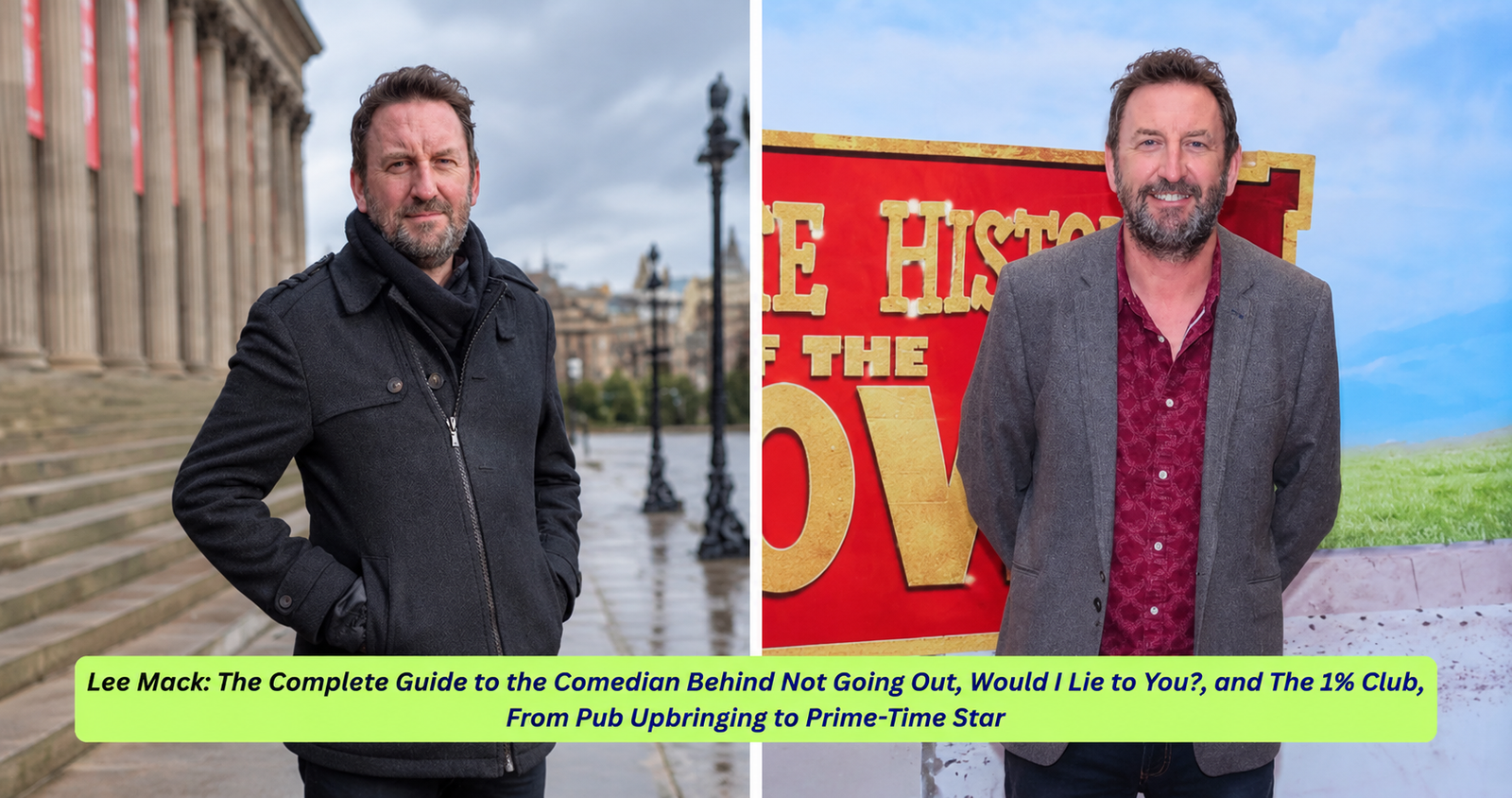
Few British entertainers can say they have anchored a sitcom, a panel show, and a primetime quiz at the same time. Lee Mack can, and he has made it look suspiciously easy for the better part of two decades. If you have ever laughed at a deadpan one-liner delivered with a straight face, groaned at a pun that was clearly too good to waste, or watched a studio audience lose control during a panel game, there is a strong chance you were watching him work.
This guide gathers what is publicly documented about his life and career. It covers his unlikely route into comedy, the sitcom that was cancelled and then revived, the format that made him a household name, and the quiz show that turned him into a Saturday-night fixture. It also looks at how to separate real information from internet noise, because celebrity searches are a magnet for recycled stories and invented rumors. Think of it as a field guide to one of the most reliable laugh-makers on British television, written to inform rather than to flatter.
Who Is Lee Mack and Why Does He Matter in British Comedy
Lee Mack is an English comedian, actor, writer, and presenter, best known for creating and starring in the BBC sitcom Not Going Out, serving as a team captain on the BBC panel show Would I Lie to You?, and hosting the ITV quiz The 1% Club. That one-sentence answer covers the majority of searches, and it sketches a career built on three very different television formats. A sitcom needs scripts and character, a panel show needs improvisation and nerve, and a quiz needs a host who can keep the pace while staying funny. Few performers handle all three with the same ease.
His birth name is Lee Gordon McKillop, and he was born on 4 August 1968, which makes him 58 at the time of writing. He is a Lancashire native with deep roots in Southport, and that northern, working-class background sits underneath much of his comic persona. The significance of his career goes beyond personal popularity. He represents a continuing tradition of British studio comedy, with its dependence on fast gags, live audiences, and performers who can switch between scripted and unscripted material, at a time when many broadcasters have moved toward single-camera, sketch, or reality formats.
Early Life: Pub Living, Odd Jobs, and the Pontins Detour
Lee Mack’s childhood was spent above a pub, which is about as good a comedy education as a young person could ask for. His parents were landlords, and reports describe him living in that environment until his parents separated, after which he settled in Southport. He has said in interviews that he grew up in a pub, and he has been candid that the culture around it shaped his early views on nightlife and, eventually, on giving up alcohol himself. A pub is a stage with no curtain, full of storytellers, hecklers, and regulars with perfect timing, and a child watching that world learns what makes a room laugh.
After school, his working life was anything but glamorous. He worked in a bingo hall and as a stable boy, and a famous footnote in his biography is that he once rode Grand National legend Red Rum. He then tried his luck as a Pontins bluecoat entertainer, a role that requires tireless cheerfulness, and by his own account it went badly enough that he was effectively sacked and sent to the Morecambe resort as a sort of punishment. Few comedians would volunteer that story, but it tells you something useful. Early failure in a high-pressure entertainment job is often the best rehearsal for stand-up, because it teaches you how silence feels and how to recover from it.
He went on to study drama at Brunel University in London, and it was there that he performed his first open-mic slot in 1994. Within about eighteen months he was working as a full-time comedian, a pace of progress that most newcomers would envy.
The Edinburgh Breakthrough and Early Stand-Up Years
The turning point arrived at the Edinburgh Festival Fringe in 1995, when he won the So You Think You’re Funny new act competition and became a full-time comedian. The competition has launched many British careers, and for good reason. It forces a new act to compress their whole identity into a few minutes in front of industry professionals, and winning it works like a stamp of approval that agents and producers recognize immediately.
In the years that followed, he built his craft through live work and collaboration. In 1999 he teamed up with Catherine Tate and Dan Antopolski for a Fringe sketch show called Bits, and the follow-up the next year was nominated for the Perrier Award, then the most prestigious prize on the Edinburgh circuit. Touring followed, and he recorded his first live DVD at London’s Bloomsbury Theatre, released in 2007. That tour-and-DVD formula is a classic comedian’s route, where live performance proves the act, the recording spreads it, and television producers take notice.
Stylistically, his stand-up leans on rapid one-liners and a persona that plays with the stereotype of the dim-witted northerner. The British Comedy Guide describes his comedy as playing up to the dim-witted northerner stereotype, especially on Would I Lie to You?. The trick is that the persona is a costume. Beneath it sits a performer with razor-sharp timing, which is why the stupidity is so convincing and the punchlines land so cleanly.
The Comedy Style: Why the Gags Land
What makes Lee Mack’s humour so effective is a combination of structure and spontaneity. His one-liners follow the traditional pattern of setup, misdirection, and punchline, but he delivers them as though the idea had only just occurred to him. That illusion of spontaneity is a skill in itself. Think of a skilled lock-picker who makes opening a door look like turning a handle. The audience sees ease, but the work happens in the preparation, the rhythm, and the willingness to abandon a planned joke when a better one appears.
There is also a problem that every quick-witted comedian has to solve. Scripted comedy rewards precision, while improvised comedy rewards speed, and the two skills pull in opposite directions. His solution has been to build the persona around a limited emotional range. The character is cheerful, slightly naive, and endlessly pun-prone, which gives him a stable base from which to ad-lib. When a panel-show guest does something unexpected, the reaction does not need to be invented from scratch. It only needs to be filtered through a character the audience already knows, and that is why his reactions feel instant and inevitable at the same time.
A practical example is a classic panel-show moment. A guest tells a bizarre story, and the room waits to see whether he will challenge it, mock it, or play along. Whichever route he takes, the audience trusts that something funny is coming, and that trust is what separates an experienced comic from a talented newcomer.
Not Going Out: The Sitcom That Refused to Die
Not Going Out premiered on BBC One in 2006, with Lee Mack creating it, co-writing it, and starring as the central character, a lovable layabout also named Lee. The setup is simple. Lee shares a flat with Lucy, played by Sally Bretton, and the dynamic between them evolves over the seasons from landlady and tenant into a married couple. Comedian Bobby Ball played Lee’s father Frank, and Mack has said that his first foray into comedy was doing Bobby Ball impressions at school when he was fifteen, which gives the casting a neat sense of full circle.
The show’s history is a story of resilience. The BBC cancelled it in 2009, but it was brought back through fan pressure, and the character gradually shifted from jack-the-lad to middle-aged grump. A comedy returning after cancellation is rare, and returning for more than a decade of additional series is rarer still. By 2025 and 2026 the sitcom had passed its hundredth episode and been recommissioned again, with the BBC’s director of comedy Jon Petrie saying that the show was in rude health. The fifteenth series arrived in 2026 as the show marked its twentieth anniversary.
Reviewers have long noted its unfussy approach. Radio Times critic Alison Graham once described it as refreshingly unpretentious, which sums up its appeal neatly. It is a studio sitcom in an age of prestige dramedies, and Mack himself has acknowledged that making an old-fashioned studio sitcom is a risk. The problem it faces is a familiar one, which is that a long-running comedy can grow stale as characters age out of their original premise. The solution has been periodic reinvention, including cast changes, such as the departure of Tim Vine, and a move to a new country house in later series, which keeps the format fresh without abandoning the joke-a-minute formula that audiences expect.
Would I Lie to You?: The Panel Show Where Lying Is an Art
Since 2007, Mack has been a regular team captain on the BBC panel show Would I Lie to You?, alongside David Mitchell as the opposing captain and Rob Brydon as host. He has been a captain there since 2007, and has also guest-hosted Have I Got News for You six times and Never Mind the Buzzcocks twice. The format is deceptively simple. Contestants tell stories about themselves or bring strange objects, and the opposing team must decide whether each claim is true or false. Success depends on reading faces, spotting inconsistencies, and, most importantly for television, being funny while doing it.
Why does it work so well? The format rewards exactly the skills he has spent a career sharpening. He can produce a quick joke in response to an outlandish claim, he can play dumb to set up a punchline, and he is willing to be the target of the joke himself. The chemistry among Mack, Mitchell, and Brydon is partly responsible for the show’s longevity, because the three have developed a rapport that makes even routine rounds feel like a comic duel. The show has been recognised with multiple BAFTA awards, and a clip from it can go viral within hours, which gives the format a second life on social media well beyond its television audience.
For viewers who want to understand why panel shows rely on repeat personalities, the answer is trust. A comedian who has appeared in dozens of episodes becomes a known quantity, and the audience starts to anticipate the shape of the comedy. That familiarity is not a weakness. It is the engine that makes a panel show feel like a conversation among friends rather than a competition among strangers.
The 1% Club and the Rise of the Quiz-Host Era
In 2022, Lee Mack took on a new role as the host of ITV’s The 1% Club, a quiz show built around questions of escalating difficulty that test logic and reasoning rather than raw trivia. The show was renewed for further series and Christmas specials, which suggests the format found a loyal audience. The structure encourages viewers to play along at home, and the tension rises as questions get harder and contestants are knocked out.
A comedian-turned-host is a savvy choice for this kind of programme. Quiz shows can feel clinical, and a host with comic instincts adds warmth and humour without slowing the game. Think of the difference between a referee who enforces the rules and one who also keeps the crowd entertained. The second kind makes the first kind look like only half the job. His natural rapport with contestants, along with a willingness to tease them gently, gives the show a more human feel than the typical high-stakes quiz.
This was not his first hosting job. He presented the Sky One panel show Duck Quacks Don’t Echo from 2014 to 2017, fronted the BBC One entertainment show All Star Cast in 2011, and presented the sports-themed panel show They Think It’s All Over. In 2022 he also appeared in BBC One’s Freeze the Fear with Wim Hof alongside Holly Willoughby. Not every venture has landed equally well, and a few formats were short-lived, but the overall pattern is that of a presenter whom broadcasters trust to carry a show.
Beyond Television: Radio, Stage, and the Written Word
Television gets most of the attention, but Mack’s career extends into radio, theatre, and publishing. In 2021 he made his debut on the BBC Radio 4 panel game I’m Sorry I Haven’t a Clue, a show with a long history of rewarding quick, silly wordplay, which suits his strengths. Radio comedy has always been a proving ground for British comedians, because without visuals the jokes have to work on language alone. He had earlier appeared on Desert Island Discs in 2013, an appearance that gave audiences a more reflective look at the man behind the wisecracks.
On stage, he appeared in the West End in 2024 as Peter in Steven Moffat’s play The Unfriend. A West End run is a different discipline from a television studio. There is no second take, no editing room, and the audience can sense every hesitation, which means the performance has to be exact night after night. For a comedian known for ad-libbing, a scripted stage comedy shows the other side of his craft, which is discipline.
Lee Mack has also written about his life. His autobiography, Mack the Life, was published by Bantam Press in 2012 and gives a first-person account of his path from the Pontins days to television success. He also received an honorary degree in 2012, a reminder that comedy, long treated as a lightweight profession, is increasingly recognised as a craft worth honouring.
Career Timeline and Key Credits at a Glance
The table below collects the most significant parts of the career in a form that is easy to scan. Years are approximate for ongoing projects.
| Project | Years | Format and Role | Why It Matters |
|---|---|---|---|
| So You Think You’re Funny (Edinburgh Fringe) | 1995 | Stand-up competition winner | Launched his professional career |
| Not Going Out | 2006 to present | BBC One sitcom; creator, co-writer, star | Long-running flagship, revived after cancellation |
| Would I Lie to You? | 2007 to present | BBC panel show; team captain | Made him a household name |
| All Star Cast | 2011 | BBC One entertainment series; presenter | Early solo hosting vehicle |
| Duck Quacks Don’t Echo | 2014 to 2017 | Sky One panel show; host | Established his hosting credentials |
| I’m Sorry I Haven’t a Clue | 2021 | BBC Radio 4 panel game; panelist | Radio debut in a classic format |
| The 1% Club | 2022 to present | ITV quiz show; host | Primetime quiz success |
| The Unfriend | 2024 | West End play; actor | Major stage credit |
Lee Mack’s career, read from top to bottom, shows a clear pattern of widening range. It begins with stand-up, moves into sitcom writing and performing, expands into panel and quiz hosting, and now includes radio and theatre. Each step built on the last, and none required abandoning the persona that audiences already loved. That continuity is the quiet secret of his longevity.
Common Misconceptions and How to Find Reliable Information
Anyone researching Lee Mack online will quickly hit a familiar problem: celebrity search results are crowded with recycled and invented stories. In July 2026, for example, several gossip pages published claims about retirement, engagement, and a break-up, and some of those pages later flagged their own stories as false. Other sites recycle years-old news and present it as current, such as stories about cancelled shows that have long since been replaced by new ones. A reader who takes those pages at face value can end up with a very distorted picture.
The solution is straightforward. Prioritise sources that are accountable for their reporting, such as official BBC and ITV pages, specialist comedy outlets like Chortle, and the British Comedy Guide, which maintains detailed credit lists and press archives. When a surprising claim appears on only one site, treat it as unconfirmed until a reputable outlet repeats it. This approach protects you from being misled and also respects the person being written about.
Smaller discrepancies are also common. Some sources place his birth in Southport and others in Blackburn, and different pages give slightly different details about his early jobs. Where reliable sources disagree, the honest approach is to say so rather than pick one version and present it as settled. That habit of cross-checking is the foundation of trustworthy writing about any public figure.
What Aspiring Comedians Can Learn From His Path
Aspiring performers can draw several lessons from this career. The first is that early failure is not fatal. Being moved out of a bluecoat role is hardly an auspicious start, yet it did not stop him from reaching the Edinburgh Fringe a few years later. The second is the value of competition circuits and festivals, where a newcomer can be seen by agents and producers in a single evening. Winning So You Think You’re Funny gave him a platform that years of unseen gigs could not have provided.
A third lesson is the importance of owning your material. By creating and co-writing Not Going Out, he secured a creative base that did not depend on other people’s commissions. When the BBC cancelled the show, the fan response helped bring it back, and that kind of loyalty is built over time through consistent quality. Consider a young comic starting out in a small city. They might write a short sitcom pilot, perform a stand-up set every week, and build an audience online. None of it guarantees success, but together these activities create options, and options are what keep a career alive when one door closes.
Finally, adaptability matters. Moving between sitcom, panel show, quiz, radio, and theatre required him to learn a new skill each time. The performers who last are usually the ones who are willing to be beginners again.
What Comes Next
Predicting a comedian’s future is always risky, but the available information points to a stable few years. Not Going Out continues with its fifteenth series, and the creator has previously talked about having a plan for how the show might eventually end, though no final date has been announced. The 1% Club remains a popular ITV format, and Would I Lie to You? continues to produce new series. Trade coverage in August 2026 also listed him among the comedians announced for the next run of the Last One Laughing format, which suggests he is open to new challenges.
The larger question is how a comedian built on studio-based formats adapts to a changing media landscape. Streaming, short-form video, and podcasts are reshaping how audiences consume comedy, but the core appeal of a quick, well-timed joke has not changed. If the past is any guide, he is likely to keep adding new roles without abandoning the old ones, and the loyalty of his audience gives him room to experiment.
Frequently Asked Questions
Who is Lee Mack?
Lee Mack is an English comedian, actor, writer, and presenter, known for creating and starring in the BBC sitcom Not Going Out, for being a team captain on Would I Lie to You?, and for hosting ITV’s The 1% Club. He was born Lee Gordon McKillop in Lancashire and rose to prominence after winning a major new-act competition at the Edinburgh Festival Fringe in 1995.
How old is Lee Mack?
He was born on 4 August 1968, which makes him 58 as of November 2026. Most reliable biographical sources agree on this date, although a few low-quality sites list slightly different years, so it is worth checking a reputable outlet if you need to confirm it.
What is his best-known work?
His best-known work includes Not Going Out, which he created and stars in, and Would I Lie to You?, on which he has been a team captain since 2007. He is also widely recognised as the host of The 1% Club on ITV, which launched in 2022.
Is Not Going Out still running?
Yes. The sitcom has been recommissioned repeatedly, and its fifteenth series aired in 2026 as the show marked its twentieth anniversary. It was famously cancelled by the BBC in 2009 and later revived after strong audience support.
Where can I watch Lee Mack shows?
Not Going Out and Would I Lie to You? are broadcast on BBC One and are generally available on BBC iPlayer in the UK, while The 1% Club airs on ITV and streams through ITVX. Availability varies by country and changes over time, so checking the broadcaster’s website or a streaming guide is the most reliable way to find current listings.
Who are the other team captain and host on Would I Lie to You?
David Mitchell is the opposing team captain, and Rob Brydon serves as host. The three have worked together for many years, and their on-screen chemistry is widely credited as a major reason for the show’s long run.
Is he married and does he have children?
Public biographies state that he married Tara McKillop in 2005, and that the couple have three children. He has generally kept his family out of the spotlight, so there is little verified detail beyond that, and it is best to avoid trusting gossip pages that claim otherwise.
Conclusion
Lee Mack has built one of the most durable careers in British comedy by combining quick-fire gags, a carefully constructed persona, and a willingness to keep trying new formats. From a childhood above a pub to an Edinburgh Fringe win, a sitcom that survived cancellation, a panel show that became a national favourite, and a quiz show that fills Saturday evenings, the pattern is one of steady growth rather than overnight fame. The best way to understand his work is to watch it, and the best way to learn about it is to rely on trusted sources rather than recycled rumor.
The final takeaway is that longevity in entertainment rarely comes from a single big break. It comes from craft, adaptability, and the trust of an audience that returns again and again. When you watch Lee Mack deliver a perfectly timed line, you are seeing the result of decades of unglamorous preparation, and that is the most useful insight his story has to offer.