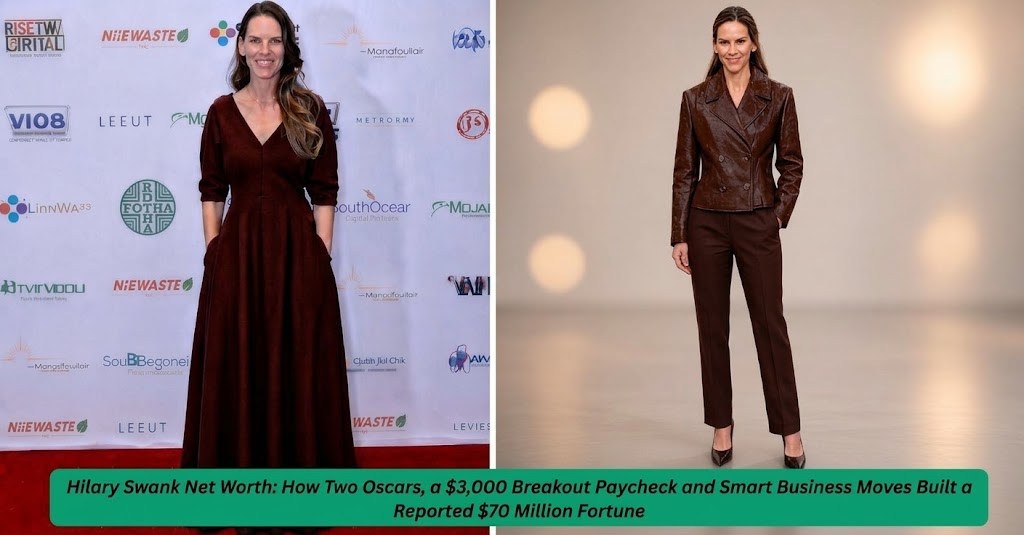
Some Hollywood fortunes are built by a single franchise that prints money for a decade. Hilary Swank’s was built the harder way: one underpaid role that changed her life, one prestige drama that finally paid her like a leading lady, and a long stretch of careful choices about what to say yes to. If you have searched for Hilary Swank net worth, the short answer is that she is widely estimated to be worth about $70 million, a figure attributed to Celebrity Net Worth and repeated by outlets such as Parade.
That number is only the starting point, though. A net worth estimate is a snapshot, not a bank statement, and the story behind it is far more interesting than the digits. In this guide, you will see where the money came from, which projects mattered most, how real estate and producing fit into the picture, why different websites publish slightly different totals, and what could move the figure next.
The Short Answer at a Glance
The most-cited estimate puts Hilary Swank net worth at roughly $70 million as of 2026. That figure comes from Celebrity Net Worth, which is the source most entertainment sites lean on, and it has stayed fairly steady across recent coverage. Swank is 52, a two-time Academy Award winner for Best Actress, and an actor who has spent more than three decades moving between film, television and producing.
It is worth being clear about what that number means. Nobody outside her accounting team can verify it, so treat $70 million as a well-informed estimate rather than an audited fact. Estimates like this are usually built from reported salaries, known property sales, producing credits and typical industry deductions. Think of it the way you would think of a home valuation on a real estate website: useful for orientation, never exact to the dollar.
From a Washington Trailer Park to Hollywood Hopeful
Swank was born in Lincoln, Nebraska, and grew up in Bellingham, Washington. Her mother, Judy Kay Swank, was a former dancer and secretary, and her father, Stephen Michael Swank, served in the Air National Guard. Money was tight in her childhood, and she has spoken in interviews about growing up in a trailer park before she and her mother moved to Los Angeles when she was around fifteen to chase an acting career. That backdrop matters for understanding her finances, because she did not arrive in Hollywood with a safety net or a famous surname.
Her early credits were modest. She appeared in the 1992 film version of Buffy the Vampire Slayer, landed a lead in The Next Karate Kid in 1994, and took a recurring role on Beverly Hills, 90210. None of those jobs made her wealthy. Early career income for working actors is usually thin and irregular, and Swank’s first decade was a classic example: steady enough to keep going, not nearly enough to build real wealth. The foundation of her later fortune would come from a role almost nobody expected to matter financially.
The $3,000 Paycheck That Changed Everything
In Boys Don’t Cry (1999), directed by Kimberly Peirce, Swank played Brandon Teena, a young transgender man whose real-life story ended in tragedy. She has said she was paid just $3,000 for the performance. The film earned her the Academy Award for Best Actress, and she beat Annette Bening, who was nominated for American Beauty. Swank was in her mid-twenties, and the role transformed how the industry saw her.
The financial irony is almost too sharp to believe. Swank has described discovering she had no health insurance when she tried to fill a prescription after winning the Oscar, explaining that “in order to have health insurance, you have to make $5,000” through the actors’ union. In her acceptance speech she said, in her own words, that she was just a girl from a trailer park who had a dream. For anyone studying Hilary Swank net worth, this moment is the true origin point: a role that paid almost nothing upfront but multiplied her market value for everything that followed.
Million Dollar Baby and the Leap Into Leading-Lady Pay
If Boys Don’t Cry opened the door, Million Dollar Baby kicked it off its hinges. In the 2004 drama, directed by Clint Eastwood, Swank played Maggie Fitzgerald, a determined boxer who persuades a gruff trainer to take her on. The film won Best Picture, Eastwood took Best Director, Morgan Freeman won Best Supporting Actor, and Swank collected her second Best Actress Oscar, again defeating Annette Bening.
On the money side, Yahoo Finance has reported that Swank earned about $3 million for the film, a figure echoed in Parade’s coverage. Some sites publish higher guesses, but the $3 million number is the one with a recognizable source behind it. Compare that with her $3,000 payday for Boys Don’t Cry and you can see the compounding effect of awards recognition: the same actress, five years apart, with a pay rate roughly a thousand times higher. It is a textbook example of how a career-defining performance converts into negotiating leverage.
Career Earnings Timeline and Key Financial Milestones
Because studios rarely publish actor contracts, the cleanest way to understand a star’s finances is to line up the milestones that are actually documented. The table below sticks to figures that have been reported by recognizable outlets and flags where numbers are uncertain.
| Milestone | Year | What Happened | Why It Matters Financially |
|---|---|---|---|
| Boys Don’t Cry | 1999 | Paid about $3,000 for the role that won her first Best Actress Oscar | Minimal pay, but it lifted her from working actor to awards-level star |
| Million Dollar Baby | 2004 | Reported pay of about $3 million; second Best Actress Oscar | Established her as a bankable lead and raised her quote for later films |
| Declined film offer | After her second Oscar | Offered $500,000 while a male co-star with no Oscars was reportedly offered $10 million | Became a landmark example of the Hollywood gender pay gap |
| 2S Films launch | Late 2000s | Co-founded a production company to develop her own projects | Gave her ownership stakes and creative control beyond acting fees |
| Pacific Palisades home sale | 2021 | Sold for about $10.1 million | One of the clearest public data points in her real estate portfolio |
| New York condo listing | Spring 2024 | Listed at more than $6 million | Shows continued property holdings in major markets |
| Alaska Daily | 2022–2023 | Lead role in the ABC drama, which ran one season | Steady television income that diversified her film-heavy résumé |
Notice how the pattern looks. Large, one-time jumps came from awards and prestige films, while the long, quieter growth came from ownership: property, production credits and smart selective work. That mix is common among actors whose wealth outlasts their peak box-office years.
When Hilary Swank Walked Away From $500,000
One of the most revealing stories about Swank’s finances is not about a deal she signed, but one she refused. After her second Oscar, she said she was offered $500,000 for a film in which a male co-star with no Oscars was offered $10 million. She turned it down. The filmmakers reportedly hired a newcomer for $50,000 instead. She did not name the movie, and the year of the offer was not specified, which is why it appears in the timeline above without a date.
The problem here is familiar to anyone who has worked in an industry with opaque pay: when compensation is secret, disparities hide in plain sight. Swank’s solution was equally familiar. She said no, preserved her price point, and invested in projects where she controlled more of the process. Over a long career, protecting your rate is often worth more than any single paycheck. It is the same logic a freelancer uses when declining a low offer so that future clients do not anchor on a bargain price. That discipline is a quiet contributor to Hilary Swank net worth, even though it never shows up as a line item.

Producing and Business Ventures: Building Equity Beyond Acting Fees
Actors earn salaries; producers earn ownership. Swank co-founded the production company 2S Films, which has developed projects she has also appeared in. Producing gives an actor a share of backend profits and the ability to shape which stories get made, which is why many established stars eventually move behind the camera. It also spreads risk: instead of relying on one role every year or two, a producer can hold interests in several projects at once.
Think of it like the difference between renting and owning. A lead-actor fee is a strong rental income for a defined period, then it ends. A production credit with equity is closer to owning a property that can keep paying out through distribution, streaming licensing and later sales. Details about specific profit shares are not public, so any outside estimate of what 2S Films adds to Hilary Swank net worth should be read cautiously. What is clear is that the company reflects a deliberate strategy to turn creative influence into lasting financial value.
Television, Streaming and Later Career Choices
As film budgets shifted toward franchises and superhero tentpoles, many established actors followed the work to television and streaming, and Swank did too. She starred in and executive produced the Netflix drama Away in 2020, then led the ABC series Alaska Daily as an investigative journalist, a show that ran for a single season. On the film side, she appeared in Ordinary Angels in 2024, and she took a guest role in the third season of Yellowjackets in 2025.
Series work changes the financial rhythm. A season of television offers predictable income over months, plus executive producer fees when an actor has a producing credit, while a film offers a larger lump sum for a shorter shoot. Neither is automatically better. What stands out about Swank’s later choices is balance: a mix of prestige television, emotionally driven films and selective guest work, rather than chasing the highest fee at every turn. For a star in her fifties, that approach keeps her visible without overextending.
Real Estate Moves and Lifestyle Spending
Real estate is the easiest part of any celebrity fortune to track, because property sales are public record. Swank sold her Pacific Palisades house in Los Angeles in 2021 for about $10.1 million, and she listed a New York City condo in spring 2024 at more than $6 million, according to Realtor-sourced reporting summarized by Parade. Those transactions suggest an investor who buys in prime markets and sells when it suits her, rather than someone who flips houses for headlines.
Property also explains why net worth estimates can look so different from one site to another. A home counts toward wealth, but a mortgage may offset part of it, and sale prices rarely equal what the owner nets after commissions, taxes and renovation costs. When you read about Hilary Swank net worth, remember that real estate is a large, relatively stable component, but it is only one slice. Liquid savings, investments and ownership stakes in production work fill in the rest of the picture, and those are exactly the parts the public never sees.
Family Life and Personal Priorities
Swank married entrepreneur Philip Schneider in 2018, and the couple has twins named Aya and Ohm. More recently, she announced on Instagram that she is expecting a third child, according to recent coverage. She lost her father in October 2021, an event she has acknowledged as a major emotional turning point. Her brother, Daniel, is also part of her close circle.
Family matters in any conversation about celebrity wealth because it reshapes spending and priorities. Parents of young children often cut back on shooting schedules, choose projects closer to home and prioritize stability. That does not necessarily reduce earnings, but it can change the type of work that gets accepted. For readers following Swank as an entertainment story and a financial story at the same time, the next few years may look quieter on screen while the underlying assets continue to work in the background.
How Net Worth Estimates Are Calculated and Why They Differ
Net worth is simple in theory: assets minus liabilities. In practice, celebrity estimates rely on a mix of public salary reports, property records, known business ventures and industry rules of thumb. A common rule of thumb in Hollywood is that agents, managers and lawyers collectively take a significant percentage of an actor’s earnings, and taxes take a large share of what remains. That means a headline salary of $3 million does not translate into $3 million of personal wealth.
This is also why you will find small inconsistencies across sites. Some pages list higher pay for Million Dollar Baby than the commonly cited $3 million, and some repeat older details about her children or her properties. When two websites disagree, the safest approach is to trust the figure that names a primary or recognizable source, and to treat any number without attribution as a rough guess. Anyone writing about Hilary Swank net worth should expect a range rather than a single perfect number, and that is the honest way to read it.
What Could Shape Her Finances Next
Several factors could nudge the estimate upward over time. New film or television roles, producing credits through 2S Films, appreciation in her property holdings and long-tail income from past projects can all contribute. Residuals, which are payments actors receive when their past work is rerun or streamed, are especially meaningful for performers with a deep library of acclaimed titles.
There are also reasons the estimate could stay flat. A slower acting schedule during early parenthood, large living and family expenses, and market swings affecting investments can all offset growth. The healthiest way to think about it is as a long-term curve rather than a daily scoreboard. Even without a new blockbuster, a catalog that includes two Best Actress wins and a producing company gives her a durable financial base.
Lessons From Hilary Swank’s Financial Journey
The first lesson is that leverage beats any single paycheck. Swank earned $3,000 for the role that made her famous, but the real payoff was the negotiating power she carried into every deal afterward. If you work in any field where reputation drives pricing, such as freelancing, consulting or design, her path is a useful reminder that one landmark project can reprice your entire career.
The second lesson is that ownership compounds. Her move into producing, along with investment in property, shows how successful people diversify beyond their main skill. A third lesson is knowing when to walk away: declining the $500,000 offer protected her rate and signaled her value. Taken together, these habits help explain why Hilary Swank net worth reached the level it did, without relying on a single franchise or viral moment.
Frequently Asked Questions
What is Hilary Swank’s net worth in 2026?
She is estimated to be worth about $70 million in 2026, according to Celebrity Net Worth, a figure repeated by outlets such as Parade. It is an estimate rather than a verified total, and it reflects acting income, production work and real estate.
How much was Hilary Swank paid for Million Dollar Baby?
Yahoo Finance reported that she earned around $3 million for Million Dollar Baby, which is the figure most commonly cited. Some websites list higher amounts, but those usually lack a clear source, so the $3 million number is the safer one to use.
How much did Hilary Swank make for Boys Don’t Cry?
She has said she was paid only $3,000 for Boys Don’t Cry, even though the role earned her the Academy Award for Best Actress. She was in her mid-twenties and later explained that the pay was too low to qualify for health insurance through the actors’ union.
Is Hilary Swank still acting?
Yes. In recent years she has worked in television and film, including Alaska Daily on ABC, the film Ordinary Angels in 2024 and a guest role in the third season of Yellowjackets in 2025. She also continues to be involved in producing through 2S Films.
How many Oscars has Hilary Swank won?
She has won two Academy Awards for Best Actress, for Boys Don’t Cry and Million Dollar Baby. Both wins came before she turned thirty-one, which is one reason her career is often cited when people discuss how early recognition can shape lifetime earnings.
Who is Hilary Swank’s husband?
Hilary Swank is married to Philip Schneider, an entrepreneur. They wed in 2018 and have twins, Aya and Ohm, with a third child reportedly on the way according to recent coverage.
Conclusion
Hilary Swank net worth, estimated around $70 million, tells a story that is bigger than any number. It starts with a $3,000 role that changed her career, grows through a $3 million turn in Million Dollar Baby, and holds steady because she paired acting fees with ownership, property and careful negotiation. Along the way she became a high-profile voice in conversations about equal pay by walking away from an offer that did not reflect her value.
The final takeaway is simple and widely applicable: lasting wealth rarely comes from a single big payday. It comes from turning recognition into leverage, leverage into ownership and ownership into freedom to choose better work. That is the quiet lesson behind Hilary Swank net worth, and it is why her financial journey is worth studying long after the last awards season ends.