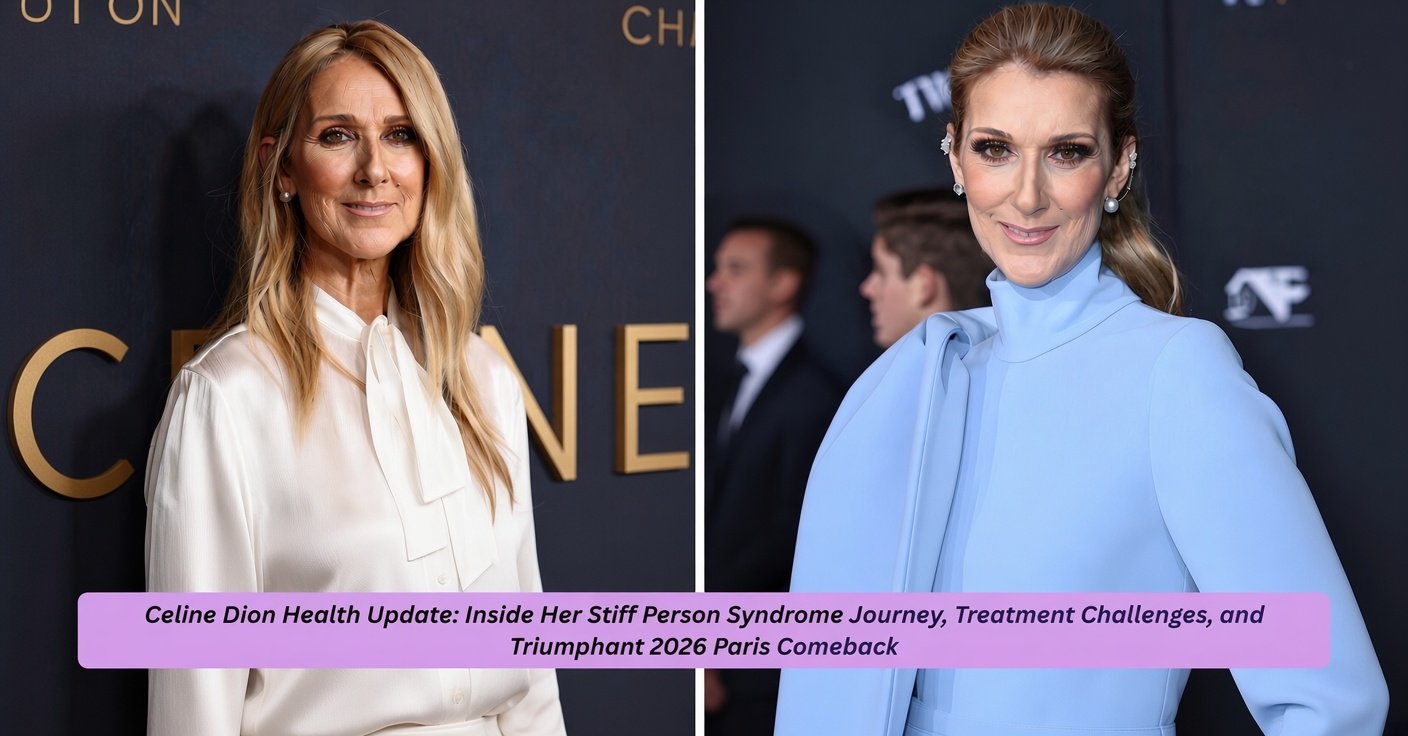
When a voice as recognizable as Celine Dion’s goes quiet, the whole world notices. For roughly four years, fans wondered what had happened to the singer behind “My Heart Will Go On,” and the answer turned out to be far more complicated than a simple case of vocal strain. Today, Celine Dion health is a subject that blends neurology, resilience, and a rare kind of public vulnerability from one of the best-selling artists in music history.
This guide walks through what has been confirmed about her condition, how it affects the body, what the 2026 Paris concerts mean, and how to read new reports carefully. Everything here is drawn from her own statements, major news outlets such as CBS News, and established medical descriptions of the disorder.
What Is Stiff Person Syndrome and Why It Defines Celine Dion Health Today
Stiff person syndrome, often shortened to SPS, is a rare, progressive neurological condition with autoimmune features. In plain terms, it is a disorder in which the nervous system keeps the muscles in a state of heightened tension, producing stiffness, painful spasms, and extreme sensitivity to triggers like sudden noise, touch, or emotional stress. The U.S. National Institute of Neurological Disorders and Stroke describes it as an incurable condition, although its symptoms can often be managed with treatment.
Celine Dion described her diagnosis herself in a December 2022 video, calling it “very rare neurological disorder called stiff person syndrome” and saying it affects roughly one in a million people. That single sentence reframed Celine Dion health from a series of cancelled shows into a clearly named medical story. Researchers believe the disorder involves antibodies that interfere with GABA, a chemical messenger that acts like the brain’s brake pedal for muscle activity. When that brake weakens, muscles can fire too easily and stay clenched, much like a car engine revving with the handbrake still on.
The condition was first described in the 1950s by physicians at the Mayo Clinic, and for decades it was misdiagnosed as anxiety, multiple sclerosis, or even a psychiatric complaint because its symptoms fluctuate. That history explains why Dion said she struggled for a long time before getting answers. Doctors generally find it more common in women, with onset often in the thirties to fifties, and it sometimes appears alongside other autoimmune conditions such as type 1 diabetes or thyroid disease.
Celine Dion Health Timeline From 2022 to the Paris Residency
Following the story chronologically makes the pattern easier to understand. The table below summarizes the major public milestones and why each one mattered.
| Date | Milestone | Why it mattered |
|---|---|---|
| December 2022 | Dion announces her stiff person syndrome diagnosis and postpones tour dates | First public explanation after years of health problems |
| May 2023 | Remaining Courage World Tour dates are cancelled | Signaled that recovery would take a long time |
| Early 2024 | Rare surprise appearance at the Grammys to present Album of the Year | Showed she was well enough for brief public moments |
| June 2024 | Documentary “I Am: Celine Dion” is released | Gave an unfiltered look at symptoms and treatment |
| July 2024 | Performance at the Paris Olympics opening ceremony | First live performance in years, closing the show with a Piaf classic |
| March 2026 | Paris concert residency announced | Confirmed a full return to the stage was planned |
| September 2026 | First full concert in six years begins her Paris run | The clearest sign of recovery progress to date |
What stands out is the slow, deliberate pace. Dion did not rush back. She reappeared in small, controlled steps, which is consistent with how clinicians often advise patients with fluctuating neurological conditions. Each appearance served as a test of what her body could handle before the next, bigger commitment.
How Dion Announced Her Diagnosis and Why Her Honesty Mattered
Before December 2022, fans had heard only vague references to health trouble and rescheduled concerts. When she finally spoke, the tone was direct and emotional. She explained that the spasms had been behind her difficulties for a long time and that she was working with a medical team to recover. In a later message about cancelling remaining tour dates, she wrote, “I’m so sorry to disappoint all of you once again,” a line that captured how seriously she treats her relationship with her audience.
That openness has had a measurable effect beyond fandom. Rare disease advocates have pointed out that celebrity disclosures often lead to spikes in public searches, more patient inquiries to neurologists, and renewed attention for research foundations. The Stiff Person Syndrome Research Foundation and similar groups have used moments like International Stiff Person Syndrome Awareness Day, observed on March 15, to build on that attention. When Dion marked that day publicly, she described overcoming the illness as one of the hardest experiences of her life and told fellow patients they could do it.
There is also a practical lesson in her approach. Rather than minimizing her symptoms or pretending everything was fine, she explained the problem, named the diagnosis, and outlined her priority, which was recovery. For anyone trying to talk about a chronic health issue with employers, family, or an audience, that sequence of clarity, specificity, and a stated goal is a useful model.
Symptoms and Their Impact on a Professional Singer
For a vocalist, the human body is the instrument, and stiff person syndrome attacks several parts of that instrument at once. Dion said the spasms affected her ability to walk and, importantly, her ability to use her vocal cords as she was accustomed. Singing at an elite level depends on precise coordination between the diaphragm, the larynx, the jaw, and dozens of smaller muscles. If any of them clench involuntarily, pitch, breath control, and stamina suffer.
The table below shows how the general symptoms of the disorder translate into specific challenges for a performer.
| General symptom | What it feels like | Impact on live performance |
|---|---|---|
| Muscle rigidity | Torso and limbs feel locked or board-like | Difficulty moving, standing for long stretches, or hitting choreography |
| Painful spasms | Sudden, intense cramps that can last minutes | Interruptions mid-song and recovery time needed between numbers |
| Sensory sensitivity | Loud sounds or touch can trigger an episode | Stage noise, crowd roar, and pyrotechnics become risk factors |
| Anxiety and fatigue | Constant tension drains energy | Reduced stamina across multi-hour shows |
This is where the problem becomes solvable in a real-world sense. A traditional arena tour, with its travel, noise, and punishing schedule, is close to the worst environment for a person with this condition. A residency in a single venue, like the one in Paris, solves several of those problems at once. There is no daily travel, the sound design can be controlled, medical support can be stationed nearby, and rest days can be planned around the body’s needs.
Treatment and Management: What Patients Typically Do
There is no cure for stiff person syndrome, so treatment aims to reduce symptoms and slow progression. Neurologists commonly prescribe medications that boost GABA activity, such as diazepam or baclofen, to ease muscle tension. Some patients receive immune-based therapies, including intravenous immunoglobulin, which can calm the autoimmune activity driving the disease. Physical therapy, stretching, and careful pacing of activity round out most care plans.
Dion has not published a full medical regimen, and it would be wrong to assume details beyond what she has shared. What she has made clear is that she works with a dedicated team and treats rehabilitation as a full-time job. Her sister Claudette Dion has said publicly, “It’s an illness we know so little about,” which is an honest reminder that even families living alongside the condition are still learning how unpredictable it can be.
For readers wondering how this compares to other health setbacks in the entertainment world, the pattern is familiar. Athletes recovering from major injuries rarely go straight from rehabilitation to a championship game. They return through practice sessions, short appearances, and carefully managed minutes. Dion’s path from the Grammys moment to the Olympics ceremony to a full concert series follows the same logic of graduated exposure.

The Documentary and Public Reappearances
The release of “I Am: Celine Dion” in June 2024 changed the public conversation. The film showed moments of genuine difficulty, including episodes where her body locked up and she needed immediate help. It did not present a sanitized recovery story. Viewers saw a woman who loves performing and who was deeply frustrated that her body would not cooperate.
Weeks later, her appearance at the Paris Olympics opening ceremony carried emotional weight precisely because audiences had just watched the documentary. Singing on the Eiffel Tower to close a four-hour broadcast, she delivered an Edith Piaf classic to a global audience in what many observers called one of the defining moments of the Games. It was not a full concert, but it was proof that her voice was still very much there.
These appearances also illustrate good communication strategy. Each reappearance was framed by context, whether a film, a ceremony, or an announcement, so the audience understood what they were seeing. That reduced speculation and gave fans an honest way to follow her progress without needing constant updates.
The 2026 Paris Comeback and What It Signals
In March 2026, Dion announced a series of concerts at Paris La Défense Arena, and demand was strong enough that additional dates were added, including some in May 2027. In September 2026, she began the run with her first full concert in six years, the first of a planned 26-show season. Reports from outlets including CBS News and Courthouse News described an emotional night in which she thanked fans for sticking with her. According to E! Online, she told the crowd, “The road was rocky,” a short phrase that captured years of effort.
For anyone tracking Celine Dion health in 2026, the comeback carries a clear takeaway: the condition has not disappeared, but it has become manageable enough for her to perform again under carefully designed conditions. A residency format, a stable home base, and a team experienced with her needs are all part of that equation. It is worth noting that a successful concert does not mean the disease is cured. It means the combination of treatment, rest, and planning is working well enough for now.
The cultural significance is also notable. Paris has long been central to her career in the French-speaking world, and returning there offers both artistic and emotional symmetry. Fans who traveled from North America and beyond treated the shows less like ordinary concerts and more like a shared celebration of resilience.
Recent Reports and Why Careful Reading Matters
Soon after the residency began, French media reported that during a show in early October 2026 Dion slipped on stage, quickly recovered with a smile and a thumbs-up, and later repeated a line of a song. A neurologist quoted in that coverage spoke about the importance of monitoring fatigue during a demanding run. At the time of writing, this account had appeared in a French outlet and had not been widely confirmed by larger international publications or by her team.
This is a good moment to explain how to evaluate stories about Celine Dion health responsibly. A stumble on stage can happen to any performer, healthy or not, especially in heels on a large set after many nights of shows. Without an official statement, it is not accurate to treat a single incident as proof of a relapse. Likewise, a repeated lyric is a common live-performance slip that has happened to nearly every touring artist.
The healthier approach is to separate what is confirmed from what is speculative. Confirmed facts include her diagnosis, her cancelled tours, her documentary, and her return to the stage. Unconfirmed items include secondhand descriptions of single moments and commentary from doctors who are not treating her. Waiting for statements from her official channels or established news agencies protects both readers and the singer’s privacy.
Why Her Story Matters for Rare Disease Awareness
Rare conditions often suffer from what advocates call a visibility problem. Patients can wait years for a correct diagnosis, and doctors may see only one or two cases in a career. When a figure like Dion explains a diagnosis in everyday language, it can shorten that road for others. Someone experiencing unexplained muscle stiffness and spasms may now know to ask a neurologist about autoimmune causes.
Her story also highlights the emotional dimension of chronic illness. Fear of disappointing others, grief over lost abilities, and the slow work of rebuilding confidence are common experiences that rarely make headlines. By discussing them openly, Dion has given patients and caregivers language to describe what they are going through. In her own words on the awareness day post, “I remain determined to one day get back onto the stage,” a sentence that now reads as both a promise and a milestone achieved.
There is a further lesson for employers, venues, and event organizers. Accommodations that help a performer with a neurological condition, such as controlled sound levels, rest periods, and fixed residencies, are not luxuries. They are the practical structures that allow talented people to keep contributing. Any workplace can learn from that principle.
How to Follow Celine Dion Health News Without Falling for Rumors
Celebrity health topics attract clickbait, and a name as big as hers is a magnet for sensational headlines. The most reliable habit is to check the original source. Her official website, verified social media accounts, and statements relayed through her representatives remain the gold standard. Reputable outlets such as CBS News, Billboard, and major wire services tend to verify claims before publishing them.
It also helps to watch for emotional language that outruns the facts. Headlines that promise a “shocking update” without naming a source usually offer little real information. Compare any new claim against what has already been confirmed, and ask whether the story names a person, a document, or an event, or only a vague “insider.” Readers who adopt this habit not only avoid misinformation but also treat the singer with the respect any patient deserves.
Finally, remember that health is not a spectator sport. Fans can express support, buy tickets, and share positive messages, but they cannot diagnose from a video clip. The best way to honor the story is to take her words at face value and let her share what she chooses, when she chooses.
Frequently Asked Questions About Celine Dion Health
What illness does Celine Dion have?
Celine Dion has stiff person syndrome, a rare autoimmune neurological disorder that causes muscle rigidity, painful spasms, and heightened sensitivity to noise and touch. She revealed the diagnosis in December 2022 after years of unexplained symptoms. Anyone searching for Celine Dion health information will find that this diagnosis is the central fact behind her cancelled tours and her long break from performing.
Is Celine Dion still alive and performing?
Yes, she is alive and has returned to performing. In September 2026 she began a Paris concert residency, her first full concert in six years, with additional dates announced into 2027. While she continues to manage a chronic condition, her return to the stage shows that her treatment and recovery plan are working well enough to support live shows.
Can stiff person syndrome be cured?
At present there is no cure for stiff person syndrome, but symptoms can often be reduced with medication, immune therapies, and physical rehabilitation. Doctors tailor treatment to each patient because the condition varies widely in severity. This is why updates on Celine Dion health emphasize management and pacing rather than a final recovery.
How rare is stiff person syndrome?
The disorder is extremely rare, with Dion herself stating that it affects about one in a million people. Because it is so uncommon, many patients are initially misdiagnosed with anxiety, multiple sclerosis, or other conditions. Raising awareness, as Dion has done, can help patients and doctors recognize the signs sooner.
Did Celine Dion get hurt on stage during her Paris concerts?
A French news outlet reported that she slipped during an October 2026 show and recovered right away, smiling and signaling that she was fine. This account has not been broadly confirmed by larger outlets or by her team, so it should be treated cautiously. When reading about Celine Dion health, it is wise to rely on official statements before drawing conclusions from a single incident.
Conclusion: What Celine Dion’s Journey Teaches Us
The story of Celine Dion health is ultimately a story about adaptation. A rare, incurable condition took away her ability to tour for years, yet she responded with honesty, patience, and disciplined rehabilitation. Her documentary showed the hard days, her Olympic performance showed the breakthroughs, and her Paris residency shows that a life shaped by chronic illness can still include moments of triumph.
The final insight is that recovery rarely follows a straight line. Progress for patients with conditions like stiff person syndrome is measured in good weeks, careful planning, and the right environment rather than in dramatic cures. Following her journey with accurate information and compassion is the most meaningful way to support her, and it offers a template for how all of us can approach the health struggles of the people we admire.