Spoiler notice: this article discusses plot points from all six series of Peaky Blinders and the 2026 film The Immortal Man.
Every great crime saga needs an enemy who does not announce herself with a gun. In Steven Knight’s Birmingham epic, that enemy arrived in a tailored coat, an American accent and a smile that never quite reached her eyes. The pairing of Anya Taylor-Joy Peaky Blinders fans remember most vividly is her turn as Gina Gray, the wife who helped turn a family wound into an assassination plot.
Years after the BBC series ended, the role keeps resurfacing. The actress herself has joked about it on talk shows, the Netflix film that continues the saga arrived without her, and viewers still argue about whether Gina is the franchise’s most hateable villain or its most underrated one. This guide covers who Gina is, how Taylor-Joy landed the part, how the character develops across series five and six, what the performer has said about her, and what her absence from the continuing story means.
What Was Anya Taylor-Joy’s Role in Peaky Blinders?
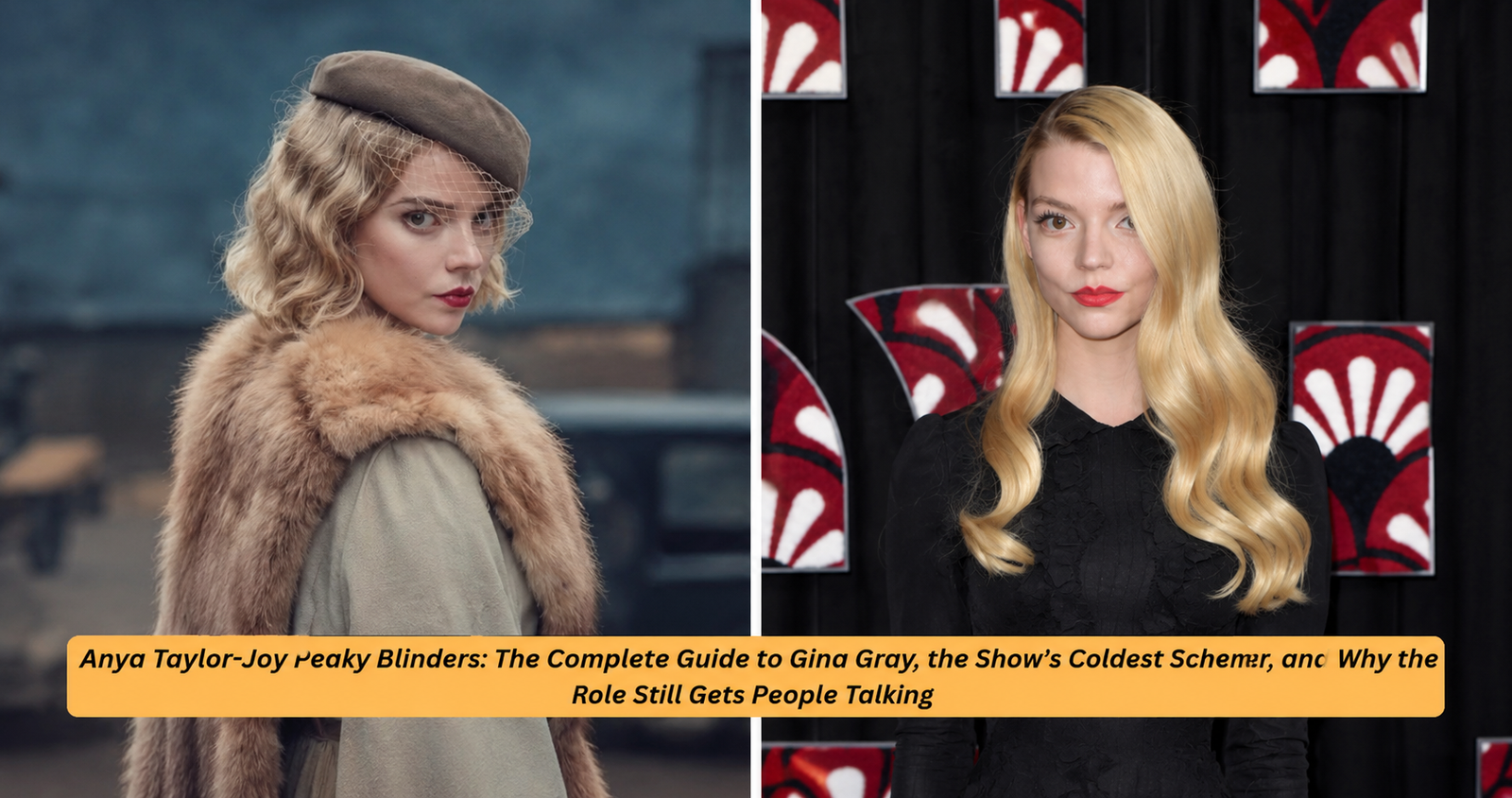
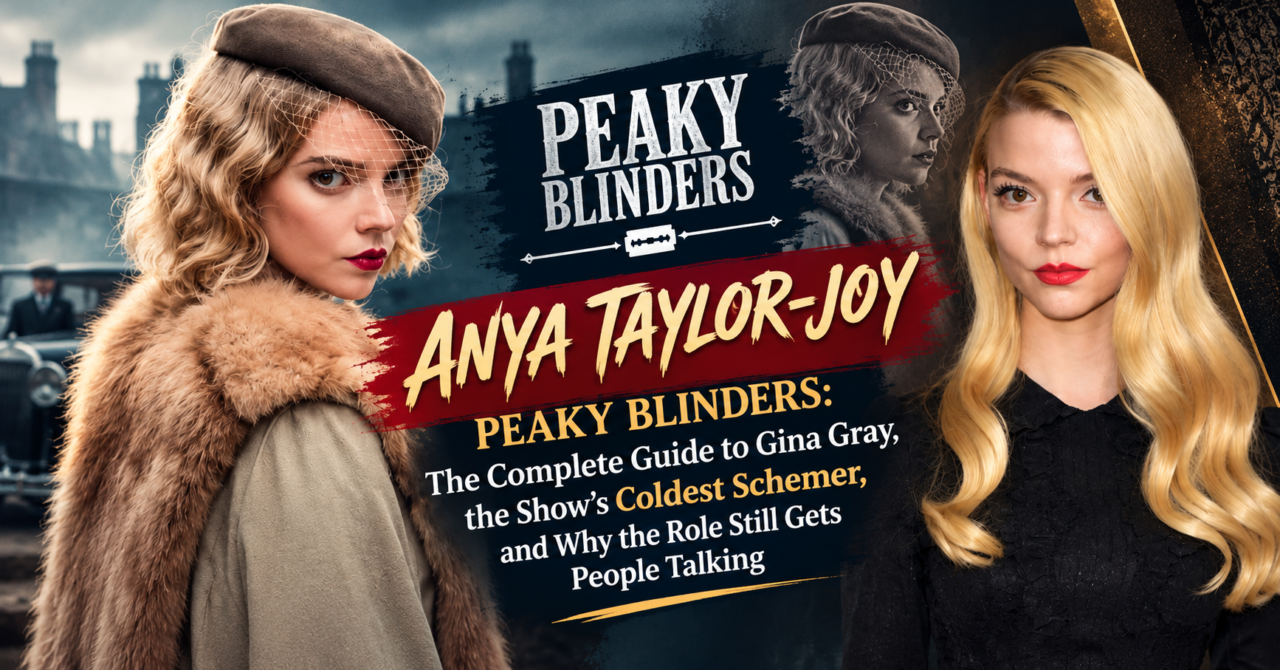
Anya Taylor-Joy played Gina Gray, the American wife of Michael Gray (Finn Cole), in the fifth and sixth series of Peaky Blinders. Gina is a calculating antagonist who encourages Michael to take control of the Shelby company and later conspires to kill Tommy Shelby (Cillian Murphy). She appears in series five (2019) and series six (2022), and she is not in the 2026 film.
That is the featured-snippet answer, but it undersells how unusual the casting was. Peaky Blinders is a show built on male violence, family loyalty and Birmingham grit, and it rarely hands an outsider this much narrative power. Gina does not carry a razor blade in her cap. She works through marriage, money and patient persuasion, which makes her a different kind of threat from the show’s earlier villains, such as Inspector Campbell, Luca Changretta and Oswald Mosley. Fans often rank her alongside them precisely because her weapon is influence rather than force.
For readers new to the franchise, the context matters. The series, created by Steven Knight, follows a Birmingham gang in the aftermath of the First World War, loosely based on a real urban youth gang that operated in the city between the 1880s and the 1910s. It began on BBC Two in 2013 and moved to BBC One for series five and six. Taylor-Joy joined at the moment the show was shifting to its biggest and darkest era, which is part of why her arrival felt like an event.
How Anya Taylor-Joy Joined the Cast
The casting news broke in 2018, when the BBC welcomed Taylor-Joy to Birmingham and shared a first-look photo taken by series five director Anthony Byrne on set in Manchester. At the time she was best known for The Witch, Split and Thoroughbreds, a run of films that had already made her a rising name in genre cinema. Her statement to Deadline was typically gracious: “I could not possibly be more excited to be joining such a talented group of people.”
There is a pattern here worth noticing. Looking back on the show’s casting history, an NME interview with Knight noted that he developed a knack for casting young actors just before they blew up. Soon after her debut in 2019, Taylor-Joy became a global name through Netflix’s The Queen’s Gambit. In other words, her Peaky Blinders run captures an actress in the narrow window between “promising” and “household name.” That timing helps explain why the role is now rewatched so closely.
Meet Gina Gray: Character Profile and Motives
Gina Gray is an American outsider in a world built on Birmingham loyalties. She enters through her marriage to Michael Gray, Polly’s son and a rising figure in the Shelby company, and she quickly shows she has ambitions of her own. In effect, she reads the family as a business with a vulnerable leadership structure and decides the structure can be changed. Reporting on the series describes her as pushing Michael to take control of the Shelby company, then scheming to remove Tommy altogether.
Think of her as a corporate raider placed inside a street gang. Where Tommy plans like a general and Arthur reacts like a brawler, Gina plans like a strategist who understands incentives. She flatters, nudges and lets other people carry the risk. Michael, who craves recognition from the family, becomes the instrument. That dynamic is why some commentators say Michael is at fault too, but that without Gina’s constant encouragement the escalation might never have happened.
Her backstory also matters for the wider plot. When series six was being previewed, Knight said the show would explore Gina’s influential American family and the social circle around Oswald Mosley. That detail places her at the intersection of wealth, politics and 1930s fascism, which raises the stakes beyond a simple family feud. She is not just a jealous spouse. She is a link between organized crime and the political forces gathering around the Shelbys.
Series Five: An Outsider Enters Birmingham
Series five opens with the world reeling from the 1929 financial crash, and Tommy Shelby, now a member of Parliament, is approached by a charismatic politician with a bold vision for Britain. Into this tense atmosphere steps Gina, introduced as a polished, composed presence who seems almost too composed. Viewers sensed from her first scenes that the air had changed.
The performance is built on small signals rather than overt menace. According to one retrospective on her casting, Taylor-Joy planted subtle clues that Gina could not be trusted, and she avoided shouting or theatrics. That restraint is a deliberate craft choice. A villain who raises her voice gives the audience an emotional release; one who stays quiet keeps the tension coiled. Series five uses this to make Gina feel like a question mark rather than an answer.
The problem for a writer in this position is how to make a scheming newcomer matter without stealing the spotlight from Tommy. The solution here was to tie her to Michael, a character with an existing emotional history in the show. Her power comes from his need, so the audience watches an established relationship curdle rather than a stranger suddenly become dangerous. That is smarter plotting than introducing a villain from nowhere, and it pays off in the final series.
Series Six: Escalation, War Clouds and the Finale
When series six premiered on February 27, 2022, it was billed as the end of the road for the television version of Peaky Blinders. Knight described it as “the end of the beginning” rather than the beginning of the end, a line that signaled more stories to come. The trailer showed Gina and Michael as a couple hunting for control of the family company, with the threat of the Second World War darkening the horizon.
The finale, titled “Lock and Key,” brings her plan to a head. Gina supports Michael’s plot to kill Tommy, and Tommy ends up killing Michael instead. The scheme collapses at the cost of her husband’s life, leaving her future and the future of the Shelby family in turmoil. For many viewers, this is the emotional core of her arc: she wins the argument inside the marriage and loses everything in the fallout.
What makes the ending interesting from a storytelling standpoint is that Gina is not punished in a traditional villain’s comeuppance. The consequences land on the person she manipulated, and she is left to live with the wreckage. That ambiguity is a major reason the character continues to generate debate. Is she a mastermind who miscalculated, or a woman whose ambition was bigger than her ability to control the men around her? The show lets both readings stand.
Why the “Worst Character” Comment Is Actually a Compliment
In March 2026, as The Immortal Man arrived on Netflix, Taylor-Joy made headlines by calling Gina potentially the “worst character” she has ever played. She made the remark on Late Night with Seth Meyers, while promoting other projects, and she added that her family is passionately attached to the character. It sounded like a put-down, but the context was affectionate: she was joking about how thoroughly audiences dislike Gina.
That reaction is exactly what the performance was designed to produce. Audiences rarely hate a villain unless the performance works. A commentary piece on the remark made this point directly, arguing that Gina is not forgettable even though she is unpopular, and that she shakes scenes with her brain rather than grabbing them by the throat. It is a useful distinction. Loud villains are easy to enjoy. Quietly manipulative ones are harder to forgive.
There is a practical lesson for anyone who writes or acts. A character can be miserable to spend time with and still be a triumph of craft. Taylor-Joy’s comment reads as a performer acknowledging that she successfully built someone the audience cannot stand, which is a more accurate compliment than being told a villain is “cool.” It also shows self-awareness, a trait she displayed in earlier interviews about the show.
How Anya Taylor-Joy Played Gina: Craft, Voice and Stillness
When she spoke to NME after wrapping the final series, Taylor-Joy described the production as stylised and enjoyable, saying the sets were “so beautifully created” and that everyone was pleased to be there. That atmosphere matters because Peaky Blinders has a heavily designed look: smoke, soot, low light, sharp tailoring. Actors who succeed in it understand that they are performing inside a painting, which rewards precision over improvisation.
Her technique for Gina can be summarized in three choices. First, an American accent that sets Gina apart from the Birmingham voices around her. Second, stillness, using pauses and eye contact in place of dialogue. Third, a gradual reveal, so that the audience’s trust erodes scene by scene rather than all at once. Imagine a chess player who never rushes a move; the pressure builds because you can see the position getting worse for the other side. That comparison feels apt given her later fame as a chess prodigy in The Queen’s Gambit.
Colleagues and critics have repeatedly noted her ability to communicate calculation without overacting. In genre work from The Witch to Split, she has shown a talent for characters whose real intentions sit just beneath the surface. Gina belongs in that lineage, but with a twist: instead of horror, the tension is political and financial.
Anya Taylor-Joy Peaky Blinders at a Glance
The table below collects the key facts in one place, which is useful for quick reference and for checking details before you rewatch.
| Detail | Information |
|---|---|
| Character | Gina Gray |
| Relationship | American wife of Michael Gray (Finn Cole) |
| Series appearances | Series five (2019) and series six (2022) |
| Casting announced | 2018, with a first-look photo from director Anthony Byrne |
| Core storyline | Pushes Michael to seize the Shelby company, then backs a plot to kill Tommy |
| Finale episode | “Lock and Key” (series six) |
| Outcome | Plot fails; Michael is killed by Tommy |
| Appears in The Immortal Man | No |
| Her comment on the role | Called Gina potentially the “worst character” she has played |
| Home of the franchise | BBC Two, then BBC One, with the film on Netflix |
Why Gina Is Absent From The Immortal Man
Anya Taylor-Joy Peaky Blinders : The Immortal Man reached Netflix on March 20, 2026, after a limited theatrical release from March 6. Written by Knight and directed by Tom Harper, it brings back Cillian Murphy as Tommy and adds new cast members including Barry Keoghan, Rebecca Ferguson and Tim Roth. Returning faces include Sophie Rundle as Ada Thorne and Stephen Graham as Hayden Stagg.
Gina is not among them. Coverage of the film listed her among the characters who did not return, noting that her last appearance was in the series six finale. Fans reacted with a mix of frustration and relief, since her storyline had ended with her scheme in ruins. A commentary piece observed that her absence still haunts the story, because the mess she helped create reshaped the Shelby legacy.
For viewers asking whether she might come back, the honest answer is that nothing has been confirmed. Netflix and the BBC have ordered two further seasons focused on a new generation, so the universe is still expanding. But no casting announcement connects Taylor-Joy to any future Peaky Blinders project, and speculation should be treated as speculation until an official source says otherwise.
Where Her Career Went After Peaky Blinders
Taylor-Joy’s career since leaving the show has been remarkable. The Queen’s Gambit and Emma in 2020 made her a household name, followed by The Northman in 2022, where she played the mystical witch Olga alongside Alexander Skarsgård. She has since voiced Princess Peach in The Super Mario Bros. Movie and its sequel, and she appears as Alia Atreides in the Dune franchise, with Dune: Part Three due in December 2026.
That trajectory puts her Peaky Blinders run in perspective. Gina was an early showcase of what she could do inside a prestige ensemble: share the screen with seasoned British actors, hold her own in a stylised world and leave a mark in limited screen time. It is the kind of role casting directors point to when they want someone who can play intelligence and danger at the same time.
It also explains why searches for Anya Taylor-Joy Peaky Blinders keep spiking whenever she has a new release. Each time she lands a major role, audiences go back to the series to see how the performance holds up. Rewatching with hindsight, many viewers say her work as Gina looks more deliberate than it did on first viewing.
How to Verify Facts About Peaky Blinders Cast and Roles
The popularity of this topic creates a familiar problem: low-quality listicles, recycled trivia and inaccurate cast details. Some pages exaggerate her screen time, confuse series numbers or invent plot developments to attract clicks. The solution is to check claims against a short list of reliable sources.
Start with trade and mainstream outlets such as Deadline and NME, which reported on her casting and interviews. Cross-check episode details against the BBC and Netflix listings, and use the show’s character index for series appearances. If an article does not give a date, a source or an attributable quote, treat it as unverified. Following that routine keeps your understanding of the Anya Taylor-Joy Peaky Blinders story grounded in facts rather than fan folklore.
Frequently Asked Questions About Anya Taylor-Joy and Peaky Blinders
Which Peaky Blinders series is Anya Taylor-Joy in?
She appears in series five and series six. Her casting was announced in 2018, and series five aired in 2019 on BBC One. Series six, the final television run, premiered in February 2022. If you want to watch all of Anya Taylor-Joy’s Peaky Blinders episodes, start at the series five premiere and continue through the finale.
Who does Anya Taylor-Joy play in Peaky Blinders?
She plays Gina Gray, the American wife of Michael Gray. Gina is a manipulative antagonist who pushes Michael toward a power grab and later supports a plot to kill Tommy Shelby. She is considered one of the show’s later-era villains, known for scheming rather than violence.
Is Anya Taylor-Joy in Peaky Blinders: The Immortal Man?
No. Gina Gray does not appear in the Netflix film, which was released on March 20, 2026, following a limited theatrical window beginning March 6. Her final appearance was in the series six finale, and the film focuses on Tommy Shelby’s return and other characters. Anyone searching for Anya Taylor-Joy Peaky Blinders updates should note that no official announcement has linked her to future installments.
Why did Anya Taylor-Joy call Gina her worst character?
She made the comment on Late Night with Seth Meyers while promoting her work, joking that Gina might be the “worst character” she has played. The remark was lighthearted and reflected how unlikable the character is, rather than any criticism of the show. She also mentioned that her family feels passionately about the role.
What happens to Gina Gray at the end of Peaky Blinders?
In the series six finale, “Lock and Key,” Gina backs Michael’s plan to kill Tommy, but the plot fails and Michael is killed. Gina’s scheme collapses, leaving her future uncertain. She does not return in The Immortal Man, so her exact fate has not been addressed on screen.
Will Anya Taylor-Joy return to Peaky Blinders?
There is no confirmation. Netflix and the BBC have ordered additional seasons exploring a new generation of the family, but casting for those projects has not included Taylor-Joy so far. Her schedule is also busy, including Dune: Part Three later this year, so any return would depend on story and availability.
Conclusion
The legacy of Anya Taylor-Joy in Peaky Blinders rests on a performance that did more with less. Gina Gray never needed a gun or a speech; she needed a quiet room and a susceptible husband. Across two series she turned patience into menace, and the audience’s lingering dislike of her is the clearest evidence that the work succeeded.
If there is one takeaway, it is that great villains are measured by what they provoke, not by how loudly they behave. Taylor-Joy’s own joke about Gina being her “worst character” is the sharpest summary of that idea. For viewers revisiting the saga, the Anya Taylor-Joy Peaky Blinders chapter is worth watching again, this time paying attention to the pauses, the glances and the moments where Gina says nothing at all.